
|
|




.png)

An innovative approach to RF patch antenna design that leverages AI to predict and optimize electromagnetic performance. This project uses inverse design principles to generate antenna geometries based on desired performance characteristics.
- ✨ Overview
- 💡 Why It Matters
- 🎯 Key Features
- 📊 Sample Outputs & Results
- 🛠️ Tech Stack
- 🚀 Getting Started
- Usage
- 🤝 Contributing
- 🙋♂️ About Me
- 📄 License
- 📬 Contact
Traditional antenna design is an iterative and often time-consuming process requiring deep domain expertise and extensive simulations. This project flips the script by employing an inverse design methodology. Instead of designing an antenna and then simulating its performance, we define the desired performance metrics (like resonant frequency and bandwidth) and use a trained neural network to generate the optimal patch antenna geometry.
This AI-driven approach significantly accelerates the design cycle, enables the exploration of novel and non-intuitive designs, and optimizes for superior electromagnetic (EM) performance.
In a world driven by wireless communication, high-performance antennas are the unsung heroes. From the 5G networks in our cities to the satellite systems orbiting our planet, the demand for faster, smaller, and more efficient antennas is exploding.
- Accelerates Innovation: By automating the most tedious parts of the design process, engineers and researchers can focus on innovation instead of manual tuning.
- Unlocks New Possibilities: AI can discover complex and unconventional antenna geometries that a human designer might never consider, leading to breakthroughs in performance.
- Powers Next-Gen Tech: This technology is crucial for advancing fields like the Internet of Things (IoT), autonomous vehicles, and space exploration, where custom, high-performance antennas are essential.
This project is a step towards making advanced antenna design more accessible, efficient, and powerful.
- Inverse Design Core: Generate antenna geometries from performance specifications.
- AI-Powered Predictions: Utilizes a neural network for fast and accurate performance analysis.
- Interactive Interface: A user-friendly
Gradiointerface allows for easy input of parameters and visualization of results. - Optimized Performance: Aims to create designs with enhanced bandwidth and efficiency.
- Extensible Framework: Easily adaptable for different frequency bands and substrate materials.
Here is an example of an antenna geometry generated by the model based on a set of input performance parameters.
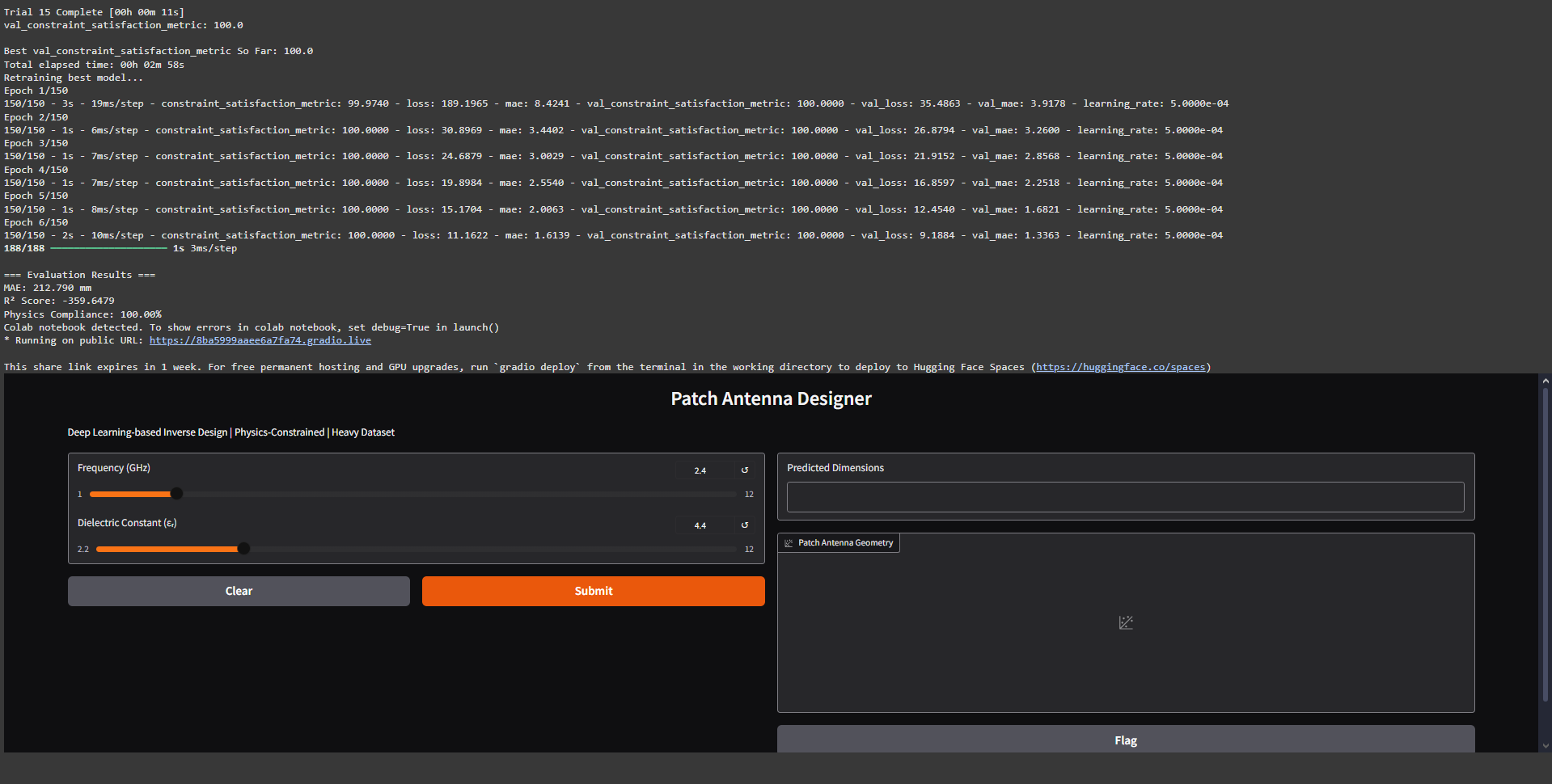
For more detailed results, please see the following files in the repository:
.png)
This project is built with a modern, open-source stack:
Follow these steps to get the project running on your local machine.
Make sure you have Python 3.9 or higher installed on your system. You can check your version with:
python --version-
Clone the repository:
git clone [https://github.com/sharvesh1401/Inverse-design-patch-antenna.git](https://github.com/sharvesh1401/Inverse-design-patch-antenna.git) cd Inverse-design-patch-antenna -
Create a virtual environment (recommended):
python -m venv venv
source venv/bin/activate  # On Windows, use `venv\Scripts\activate`
-
Install the required dependencies:
pip install -r requirements.txt
Once the installation is complete, you can launch the interactive application.
-
Run the Gradio App:
python app.py
-
Access the Interface: Open your web browser and navigate to the local URL provided in the terminal (usually
http://127.0.0.1:7860). -
Design Your Antenna:
- Enter your desired performance parameters (e.g., resonant frequency).
- Click the "Generate" button.
- The application will display the predicted antenna geometry and its performance characteristics.
Contributions are what make the open-source community such an amazing place to learn, inspire, and create. Any contributions you make are greatly appreciated.
If you have a suggestion that would make this better, please fork the repo and create a pull request. You can also simply open an issue with the tag "enhancement".
- Fork the Project
- Create your Feature Branch (
git checkout -b feature/AmazingFeature) - Commit your Changes (
git commit -m 'Add some AmazingFeature') - Push to the Branch (
git push origin feature/AmazingFeature) - Open a Pull Request
I'm Sharvesh Selvakumar, an engineering student passionate about AI, clean energy, and responsible tech.
🔗 Portfolio: sharveshfolio.netlify.app
🐦 Twitter: @Sharvesh_14
This project is distributed under the MIT License. See the LICENSE file for more information.
Sharvesh Selvakumar - s_sharvesh@outlook.com
Project Link: https://github.com/sharvesh1401/Inverse-design-patch-antenna