Dynamic configuration for Python applications.



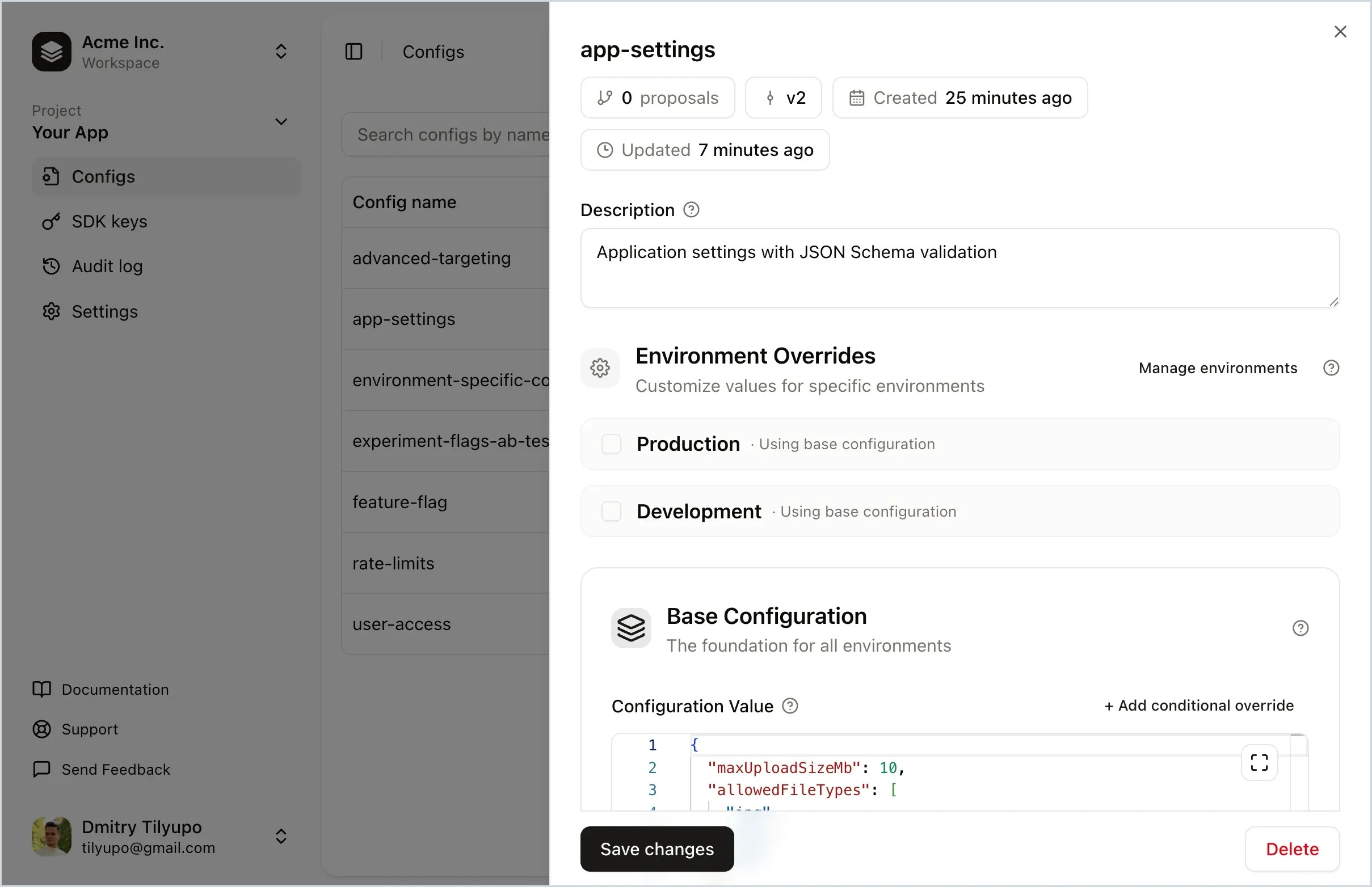
Replane is a dynamic configuration manager that lets you tweak your software without running scripts or building your own admin panel. Store feature flags, rate limits, UI text, log level, rollout percentage, and more. Delegate editing to teammates and share config across services. No redeploys needed.
- Feature flags – toggle features, run A/B tests, roll out to user segments
- Operational tuning – adjust limits, TTLs, and timeouts without redeploying
- Per-environment settings – different values for production, staging, dev
- Incident response – instantly revert to a known-good version
- Cross-service configuration – share settings with realtime sync
- Non-engineer access – safe editing with schema validation
- Real-time updates via Server-Sent Events (SSE)
- Context-based overrides for feature flags, A/B testing, and gradual rollouts
- Zero dependencies for sync client (stdlib only)
- Both sync and async clients available
- Type-safe with TypedDict support and full type hints
- Testing utilities with in-memory client
# Basic installation (sync client only, zero dependencies)
pip install replane

# With async support (adds httpx dependency)
pip install replane[async]from replane import Replane
# Using context manager (recommended)
with Replane(
base_url="https://replane.example.com",
sdk_key="rp_...",
) as replane:
# Get a simple config value
rate_limit = replane.configs["rate_limit"]
# Get with context for override evaluation
user_client = replane.with_context({"user_id": user.id, "plan": user.plan})
feature_enabled = user_client.configs["new_feature"]
# Get with fallback default
timeout = replane.configs.get("request_timeout", 30)Requires pip install replane[async]:
from replane import AsyncReplane

async with AsyncReplane(
    base_url="https://replane.example.com",
    sdk_key="rp_...",
) as replane:
    # Access configs from local cache
    rate_limit = replane.configs["rate_limit"]

    # With context
enabled = replane.with_context({"plan": "premium"}).configs["feature"]from replane import Replane
# Option 1: Provide credentials in constructor
replane = Replane(
base_url="https://replane.example.com",
sdk_key="rp_...",
)
replane.connect()
# Option 2: Provide credentials in connect()
replane = Replane()
replane.connect(
base_url="https://replane.example.com",
sdk_key="rp_...",
)
# Use configs
rate_limit = replane.configs["rate_limit"]
user_client = replane.with_context({"user_id": "123"})
feature = user_client.configs["feature_flag"]
# Don't forget to close when done
replane.close()Generate TypedDict types from your Replane dashboard for full type safety:
from replane import Replane
from replane_types import Configs  # Generated from Replane dashboard

# Use the Configs TypedDict as a type parameter
with Replane[Configs](
    base_url="https://replane.example.com",
    sdk_key="rp_...",
) as replane:
    # Access configs with dictionary-style notation
    settings = replane.configs["app_settings"]

    # Full type safety - IDE knows the structure of settings
    print(settings["max_upload_size_mb"])
    print(settings["allowed_file_types"])

    # Check if config exists
    if "feature_flag" in replane.configs:
        flag = replane.configs["feature_flag"]

    # Safe access with default
    timeout = replane.configs.get("timeout", 30)
The .configs property provides:
- Dictionary-style access with
replane.configs["config_name"] - Type inference when using generated TypedDict types
- Override evaluation using the default context
- Familiar dict methods:
.get(),.keys(),inoperator
Both clients accept the same configuration:
replane = Replane(
    base_url="https://replane.example.com",
    sdk_key="rp_...",

    # Default context applied to all config evaluations
    context={"environment": "production"},

    # Default values used if server is unavailable during init
    defaults={
        "rate_limit": 100,
        "feature_enabled": False,
    },

    # Configs that must exist (raises error if missing)
    required=["rate_limit", "feature_enabled"],

    # Timeouts in milliseconds
    request_timeout_ms=2000,
    initialization_timeout_ms=5000,
    retry_delay_ms=200,
    inactivity_timeout_ms=30000,

    # Custom agent identifier for User-Agent header
    agent="my-app/1.0.0",

    # Enable debug logging
    debug=True,
)Replane evaluates override rules client-side using the context you provide. Your context data never leaves your application.
# Define context based on current user/request
context = {
    "user_id": "user-123",
    "plan": "premium",
    "region": "us-east",
    "is_beta_tester": True,
}

# Overrides are evaluated locally using with_context()
value = replane.with_context(context).configs["feature_flag"]Create scoped clients for specific users or requests using with_context():
with Replane(
    base_url="https://replane.example.com",
    sdk_key="rp_...",
) as replane:
    # Create a scoped client for a specific user
    user_client = replane.with_context({
        "user_id": user.id,
        "plan": user.plan,
    })

    # All operations use the merged context
    rate_limit = user_client.configs["rate_limit"]
    settings = user_client.configs["app_settings"]

    # Can be chained for additional context
    request_client = user_client.with_context({"region": request.region})
The original client is unaffected - scoped clients are lightweight wrappers.
Create scoped clients with fallback values using with_defaults():
with Replane(
    base_url="https://replane.example.com",
    sdk_key="rp_...",
) as replane:
    # Create a client with fallback defaults
    safe_client = replane.with_defaults({
        "timeout": 30,
        "max_retries": 3,
    })

    # Returns the default if config doesn't exist
    timeout = safe_client.configs["timeout"]  # 30 if not configured

    # Chain with with_context() for both features
    user_client = replane.with_context({"plan": "premium"}).with_defaults({
        "rate_limit": 1000,
    })
Explicit defaults in .configs.get() take precedence over scoped defaults.
Percentage rollout (gradual feature release):
# Server config has 10% rollout based on user_id
# Same user always gets same result (deterministic hashing)
enabled = replane.with_context({"user_id": user.id}).configs["new_checkout"]
Plan-based features:
max_items = replane.with_context({"plan": user.plan}).configs["max_items"]
# Returns different values for free/pro/enterprise plans
Geographic targeting:
content = replane.with_context({"country": request.country}).configs["homepage_banner"]React to config changes in real-time:
# Subscribe to all config changes
def on_any_change(name: str, config):
    print(f"Config {name} changed to {config.value}")

unsubscribe = replane.subscribe(on_any_change)

# Subscribe to specific config
def on_feature_change(config):
    update_feature_state(config.value)

unsubscribe_feature = replane.subscribe_config("my_feature", on_feature_change)

# Later: stop receiving updates
unsubscribe()
unsubscribe_feature()
For async clients, callbacks can be async:
async def on_change(name: str, config):
    await notify_services(name, config.value)

replane.subscribe(on_change)from replane import (
ReplaneError,
TimeoutError,
AuthenticationError,
NetworkError,
ErrorCode,
)
try:
value = replane.configs["my_config"]
except KeyError as e:
print(f"Config not found: {e}")
except TimeoutError as e:
print(f"Timed out after {e.timeout_ms}ms")
except AuthenticationError:
print("Invalid SDK key")
except ReplaneError as e:
print(f"Error [{e.code}]: {e.message}")Use the in-memory client for unit tests:
from replane.testing import create_test_client, InMemoryReplaneClient

# Simple usage
replane = create_test_client({
    "feature_enabled": True,
    "rate_limit": 100,
})

assert replane.configs["feature_enabled"] is True

# With overrides
replane = InMemoryReplaneClient()
replane.set_config(
    "feature",
    value=False,
    overrides=[{
        "name": "premium-users",
        "conditions": [
            {"operator": "in", "property": "plan", "expected": ["pro", "enterprise"]}
        ],
        "value": True,
    }],
)

assert replane.with_context({"plan": "free"}).configs["feature"] is False
assert replane.with_context({"plan": "pro"}).configs["feature"] is Trueimport pytest
from replane.testing import create_test_client
@pytest.fixture
def replane_client():
return create_test_client({
"feature_flags": {"dark_mode": True, "new-ui": False},
"rate_limits": {"default": 100, "premium": 1000},
})
def test_feature_flag(replane_client):
flags = replane_client.configs["feature_flags"]
assert flags["dark_mode"] is TrueIf you prefer not to use context managers:
# Sync
replane = Replane(base_url="...", sdk_key="...")
replane.connect()  # Blocks until initialized
try:
    value = replane.configs["config"]
finally:
    replane.close()

# Async
replane = AsyncReplane(base_url="...", sdk_key="...")
await replane.connect()
try:
    value = replane.configs["config"]
finally:
await replane.close()from contextlib import asynccontextmanager
from typing import Annotated
from fastapi import FastAPI, Depends
from replane import AsyncReplane
_replane: AsyncReplane | None = None
@asynccontextmanager
async def lifespan(app: FastAPI):
global _replane
_replane = AsyncReplane(
base_url="https://replane.example.com",
sdk_key="rp_...",
)
await _replane.connect()
yield
await _replane.close()
app = FastAPI(lifespan=lifespan)
def get_replane() -> AsyncReplane:
assert _replane is not None
return _replane
# Define reusable dependency type
Replane = Annotated[AsyncReplane, Depends(get_replane)]
@app.get("/items")
async def get_items(replane: Replane):
max_items = replane.with_context({"plan": "free"}).configs["max_items"]
return {"max_items": max_items}from flask import Flask, g
from replane import Replane
app = Flask(__name__)
_replane: Replane | None = None
@app.before_first_request
def init_replane():
global _replane
_replane = Replane(
base_url="https://replane.example.com",
sdk_key="rp_...",
)
_replane.connect()
@app.route("/items")
def get_items():
max_items = _replane.configs["max_items"]
return {"max_items": max_items}- Python 3.10+
- No dependencies for sync client
httpxfor async client (pip install replane[async])
See CONTRIBUTING.md for development setup and contribution guidelines.
Have questions or want to discuss Replane? Join the conversation in GitHub Discussions.
MIT