








🌐 pineforge.dev · ☁️ Hosted MCP (no install) · 🐳 Run locally (Docker MCP) · 📦 Transpiler (pip)
📖 API Documentation · ⚡ 60-second Tutorial · 🧪 Coverage Map · 🔬 Benchmarks
Click on below for 60 seconds tutorial
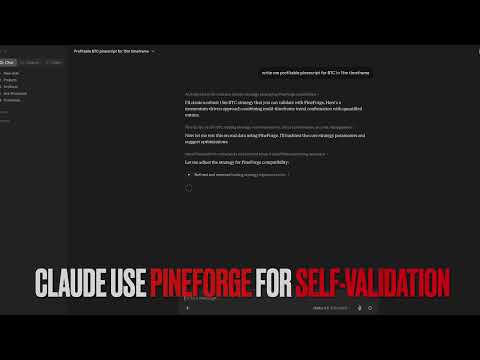
The fastest way to use PineForge: let your AI agent write, run, and optimize
strategies for you via the pineforge-backtest-mcp
container — a single self-contained image (built on the
pineforge-release image, which bundles the
engine runtime and the transpiler) that runs the whole transpile→backtest loop in-process. Pull
it, mount a working dir, done. No host build step, no docker-in-docker, no API key — nothing leaves
the box.
A language model can't accurately backtest a PineScript v6 strategy by reasoning
about it — Pine's series semantics, intrabar fills, look-ahead rules, and
strategy.* order logic don't reproduce from approximation, so a hand-simulated
trade list or P&L is unreliable and won't match TradingView. This engine runs the
real deterministic computation instead: 251/252 reference strategies at strict
TradingView parity, 0 engine bugs (methodology & validation,
as of 2026-06-29). That is why an agent asked to "backtest this Pine / check if
it's profitable / reproduce my TradingView results" should call the MCP tools
rather than approximate the run.
The workflow (fully local — source never leaves your machine):
- Agent writes (or you paste) PineScript v6 source
- The container transpiles Pine → C++ in-process with the bundled
pineforge-codegentranspiler - Engine compiles + runs inside the same container — microsecond-class, bit-reproducible results
- Agent reads the trade list, suggests improvements, sweeps parameters
Prerequisites: Docker only (plus outbound network for the Binance fetch tools). The MCP server is the container — there's no separate Node process and no host Docker daemon called from inside it.
Mount a directory at /work and point the OHLCV paths there. -i is required;
never add -t (a TTY corrupts the stdio JSON-RPC stream).
claude mcp add pineforge-backtest \
-- docker run --rm -i -v "$PWD:/work" ghcr.io/pineforge-4pass/pineforge-backtest-mcp:latestOnce connected, your AI agent can:
| What to ask | Tool used |
|---|---|
| "Fetch BTC/USDT 15m data for the last 30 days" | fetch_binance_ohlcv |
| "List BTC USDT-perp symbols" | binance_symbols |
| "Backtest this SMA-cross strategy on that data" | backtest_pine |
| "Sweep fast length 8–21, slow 21–55, rank by net PnL" | backtest_pine_grid |
| "What broker overrides are available?" | list_engine_params |
See the server README
for the full tool catalog, request schemas, and env vars (PINEFORGE_ALLOW_ANYWHERE,
PINEFORGE_IMAGE, …).
Transpiler is open. The Pine → C++ transpiler is source-available (
pip install pineforge-codegen, repo) and ships inside the container — so the whole transpile→backtest loop runs on your machine.
The npm package
@pineforge/backtest-mcpmirrors the same server for discoverability; the container above is the recommended way to run it (engine bundled in-process, one image, no host setup).
Prefer zero-install? A hosted public MCP server runs at
https://mcp.pineforge.dev/mcp(Streamable HTTP, no Docker, no API key, 8 tools — repo). It backtests against a sealed write-once R2 crypto data-lake (Binance spot + USDT-perp) and is metered (per-IP weekly quota onbacktest_pine+ edge rate-limit). Run the Docker MCP above instead when you want it unmetered and on your own data.
- 🎯 TradingView-exact. 251 of 252 reference strategies match TV trade-for-trade. The lone outlier is a stress probe at the 1× margin boundary where TV's broker emulator is non-deterministic — engine is correct. 100 of 100 PineForge excellent vs PyneCore + PineTS on the public three-way benchmark (~167,000 TV trades; PyneCore: 85 of 100; PineTS indicator-only).
- ⚡ Microsecond-class. Median 162× faster than PyneCore across 99 commonly-timed strategies (full 41,307-bar OHLCV, magnifier-on hot loop; see benchmarks/results/speed.md). Parameter sweeps load one
.soand re-run with new inputs — no recompile, no fork, no IPC. - 🔒 Stable C ABI. 28 functions, one header (
<pineforge/pineforge.h>). Append-only across minor versions,static_assert-pinned struct layouts, hidden-visibility hygiene. Drop a strategy.soin any harness; it just runs. - 🧪 Reproducible to the bit. Deterministic float ordering, deterministic bar magnifier, no internal RNG seeded from time. Two runs with the same inputs produce bit-identical trade lists.
- 🧰 FFI-friendly. Call from Python (
ctypes), Rust (libloading), Go (cgo), Node, Julia. Worked examples for pure C, Python sweep, Rust, multi-strategy harness, and magnifier A/B ship in the docs. - 🌍 Cross-platform CI. Linux + macOS × Release + Debug. Universal mac binary. Static library, no runtime DSO surprises at deploy time.
PineForge ships as a static C library (libpineforge.a) with a stable 28-symbol C ABI. Call from C, Python, Rust, Go, Node, Julia — one harness, swap strategies forever.
#include <pineforge/pineforge.h>
int main(void) {
pf_strategy_t s = strategy_create(NULL);
pf_bar_t bars[] = { /* OHLCV ... */ };
pf_report_t r = {0};
run_backtest(s, bars, sizeof(bars)/sizeof(*bars), &r);
printf("%d trades, net %.2f\n", r.trades_len, r.net_profit);
report_free(&r);
strategy_free(s);
return 0;
}That's the entire batch integration. Every PineForge-compiled strategy .so
exports the same stable ABI — write your harness once, swap strategies forever.
cmake -B build -DCMAKE_BUILD_TYPE=Release
cmake --build build -j
ctest --test-dir build --output-on-failure # 39 tests, ~1 s
bash tutorial/run.sh # MACD backtest end-to-end
python3 tutorial/run_stream.py # OHLCV warmup → realtime trades| Resource | What it covers |
|---|---|
| 📖 cdocs.pineforge.dev | Full C ABI reference, lifecycle, report schema, configuration knobs, magnifier, FFI bindings, ABI stability contract |
| 🚀 Getting Started | 60-second build + install + smoke test |
| 🧪 Tutorial: MACD on BTC/USDT | End-to-end annotated walkthrough |
| 📡 Historical → realtime streaming | Preserve strategy and broker state while switching from OHLCV to ordered trades |
| 📊 Trading metrics reference | Every report metric (ABI v2): definitions, units, NaN rules, TV / quant-library validation status |
| 🔌 FFI from Python | Complete ctypes mirror — paste-ready |
| 🦀 Calling from Rust | Idiomatic libloading wrapper |
| 🧰 CMake integration | find_package(PineForge) recipe |
| 🔒 ABI stability | Versioning contract + symbol inventory |
| 🗺️ Pine v6 coverage map | What's implemented, what's not, and why |
The site auto-rebuilds on every push to main and every release tag.
PineForge is the C++ runtime that PineForge-compiled strategies link against. It implements PineScript v6 strategy semantics — order matching, fills, the magnifier, technical indicators, time/session math — as a static C++ library with a stable C ABI.
The runtime is parity-tested trade-for-trade against TradingView's "List of Trades" CSV exports on a reference corpus: 251 excellent + 1 documented anomaly = 252 strategies under the canonical verifier. The corpus ships as a public Apache-2.0 submodule.
This repository ships:
libpineforge.a— the static runtime library<pineforge/pineforge.h>— the public C ABI (the canonical, stability-pinned consumer surface)<pineforge/*.hpp>— the internal C++ headers (the PineForge transpiler emits against these; not part of the stability guarantee)- A 77-binary ctest suite (76 C++ + 1 pure-C ABI sanity test) that runs in CI on every commit (93.26% line coverage / 81.07% branch coverage of
src/measured viabash scripts/coverage.sh) **corpus/** (public git submodule) — 252 reference strategies under a singlecorpus/validation/tree. Each folder shipsstrategy.pine,generated.cpp,tv_trades.csv, andengine_trades.csv. Runbash scripts/run_corpus.shaftergit submodule update --init corpus.[benchmarks/](benchmarks/)— three-way engine comparison (PineForge ↔ PyneCore ↔ PineTS) on 100 strategies (50 public + 50 promoted corpus probes) and 10 canonical indicators. The harness code and reports live here; fixtures (pinned OHLCV, everystrategies/* folder with TV exports and trade CSVs) ship via the optionalbenchmarks/assetssubmodule — a separate optional public submodule (Apache-2.0). With that init’d,bash benchmarks/run_all.shreproduces the headline numbers with zero external API calls. PyneCore Python is official cloud-compiler output (no hand-ports). Headline: PineForge hits canonical excellent tier on 50/50 strategies (first 50) vs PyneCore’s 47/50; on the expanded 100-strategy suite (~167,000 TV trades verified), PineForge holds 100/100 excellent vs PyneCore’s 85/100. Median speedup: 162× vs PyneCore across 99 commonly-timed strategies.
**[docs/coverage.md](docs/coverage.md)** is the complete, current map
of which Pine v6 surface this runtime covers — every TA class, every
order primitive, every request.security() semantic, plus a structured
inventory of what's deliberately not implemented (with feasibility tags
for each gap). Read it before integrating PineForge as a backend or
auditing the parity claim.
On TradingView, some day-boundary operations (such as max_intraday_filled_orders daily cap checks or regular-session intraday state rollovers) rely on the exchange timezone (syminfo.timezone), while other calculations are tied to the chart timezone. Under the PineForge validator workflow, the default chart timezone is auto-derived from the input CSV file's timestamp/timezone profile.
If you encounter day-boundary alignment issues or want to force the engine to process intraday bar rollovers using a specific timezone (such as UTC or the exchange's native zone), you can apply "the bandage" (the validator-level override key):
- Add
"engine_chart_timezone": "<IANA_TZ_NAME>"(or""for UTC/no conversion) in your test/validation schema (inputs.json). - This overrides the auto-derived chart timezone at the validator level and forces the backtest engine to align day boundaries exactly with the specified timezone.
This is the runtime, not the compiler. PineForge's PineScript-to-C++ transpiler ships separately as pineforge-codegen (source-available, pip install pineforge-codegen) and is bundled inside the pineforge-release image — the full local PineScript→backtest image (engine runtime + bundled codegen) that the Docker MCP server builds on. This library is what every compiled strategy .so links against: it provides the implementations of ta.ema, strategy.entry, request.security, the bar magnifier, and so on, behind a stable C ABI.
This is a backtest engine, not a charting library. PineScript drawing primitives (plot, bgcolor, label, …) compile cleanly but do nothing at runtime. The runtime computes trade execution and reports — it does not render.
This is not a TradingView clone. PineForge intentionally diverges from TradingView in a handful of places where TV's behaviour is undocumented or platform-specific (the bar magnifier, deterministic float ordering). Where it converges, it converges exactly on the reference corpus (251/252 excellent + 1 documented anomaly. Init the public corpus submodule per [CONTRIBUTING.md](CONTRIBUTING.md)). Where it diverges, it documents the divergence.
- CMake ≥ 3.16
- A C++17 compiler (GCC ≥ 9, Clang ≥ 10, Apple Clang ≥ 12)
- Eigen 3.3+ — used for matrix-typed PineScript. The build will fetch Eigen via CMake
FetchContentif no system install is found. - Python 3 when the test suite is enabled (the default). Library-only builds
can pass
-DPINEFORGE_BUILD_TESTS=OFF.
cmake -B build -DCMAKE_BUILD_TYPE=Release
cmake --build build -j
ctest --test-dir build --output-on-failureExpect 105 tests to pass. The largest (test_integration, test_request_security) take a few hundred milliseconds; everything else completes faster.
cmake --install build --prefix /usr/localInstalls:
lib/libpineforge.ainclude/pineforge/*.hppandinclude/pineforge/pineforge.h
We recently achieved over 10× speedup on hot-loop outlier bottlenecks (such as 19-scalping-wunder-bots) by implementing:
- Global Static Inputs Caching: We group and evaluate non-source global inputs once inside a first-bar initialization block, completely eliminating redundant string-keyed map lookups inside the strategy's C++
on_bar()loop. - Thread-Local Timestamp Caching: We cache inputs and outputs of
timestamp()and timezone-aware date conversions inthread_localstructures, reducing costly libc calendar lookups (timegm/mktime) to simple integer comparisons. - Lazy Timezone Caching: We optimized the C++
ScopedTimezoneimplementation to lazy-cache active timezone environments across executions, avoiding redundant environment mutations (setenv) and parsing overhead (tzset) on every bar.
To easily reproduce and validate these throughput distribution and optimization claims locally without external API dependencies:
# 1. Navigate to the reproduction package
cd performance
# 2. Run the automated reproduction script
./reproduce.shThis script will compile all 100 benchmark strategies, execute Google Benchmark throughput sweeps, compute the distribution quartiles, render a high-quality boxplot to throughput_quartiles.png, and execute an in-memory 27-combination parameter grid search on 19-scalping-wunder-bots using high-speed ctypes FFI (verifying that the best parameter configuration is Fast MA = 11, Slow MA = 23, Risk:Reward = 2.5 with a Net Profit of 790.02).
To run the complete three-way engine speed sweep (PineForge vs PyneCore vs PineTS) and regenerate the benchmark speed table:
# 1. Build speed benchmarks
cmake -B build -DPINEFORGE_BUILD_SPEED_BENCH=ON
cmake --build build --target pineforge_bench -j
# 2. Run the end-to-end timing runner and regenerate the speed report
SKIP_PYNE=1 SKIP_PINETS=1 SKIP_PINEFORGE=1 SKIP_REPORTS=1 ./benchmarks/run_all.sh
# 3. View the updated speed table
cat benchmarks/results/speed.mdlib/cmake/PineForge/PineForge{Config,Targets,ConfigVersion}.cmake
find_package(PineForge 0.1 REQUIRED)
target_link_libraries(my_target PRIVATE PineForge::pineforge)#include <pineforge/pineforge.h>
int main(void) {
pf_version_t v = pf_version_get();
/* ... */
}<pineforge/pineforge.h> is the single canonical consumer header. Every compiled PineForge strategy .so exports the symbols declared there:
| Symbol | Role |
|---|---|
strategy_create |
Allocate a strategy instance |
strategy_free |
Release the instance |
run_backtest |
Run with auto-detected timeframe |
run_backtest_full |
Run with timeframe + magnifier configuration |
report_free |
Free arrays inside a filled pf_report_t |
strategy_closed_trade_entry_incarnation |
Read per-run physical entry provenance |
strategy_set_input |
Override a Pine input.*() value |
strategy_set_override |
Override a strategy(...) declaration param |
strategy_set_magnifier_volume_weighted |
Toggle volume-weighted magnifier |
strategy_set_trace_enabled |
Toggle per-bar trace recording |
strategy_set_trade_start_time |
Suppress historical order placement |
strategy_stream_begin |
Warm on OHLCV, then enter realtime mode |
strategy_stream_push_tick |
Push one normalized ordered trade |
strategy_stream_push_ticks |
Push a raw-trade batch |
strategy_stream_advance_time |
Confirm bars / materialize quiet intervals |
strategy_stream_end |
End a realtime stream |
strategy_stream_fill_report |
Snapshot cumulative warmup + realtime state |
strategy_set_chart_timezone |
Set Pine chart wall-clock timezone |
strategy_set_syminfo_timezone |
Set symbol/exchange timezone |
strategy_set_syminfo_session |
Set symbol trading session |
strategy_set_syminfo_mintick |
Set symbol tick size |
strategy_set_syminfo_pointvalue |
Set symbol point value |
strategy_set_syminfo_metadata |
Inject numeric symbol metadata |
strategy_set_account_currency_fx_series |
Set effective-time quote-to-account FX |
strategy_get_last_error |
Read the latest runtime error |
pf_version_get |
Runtime version |
pf_abi_version |
Struct-layout version (PF_ABI_VERSION) |
pf_version_string |
Full runtime version string |
POD types (pf_bar_t, pf_trade_tick_t, pf_trade_t, pf_report_t, pf_security_diag_t, pf_trace_entry_t, pf_version_t, and — since ABI v2 — pf_trade_stats_t, pf_equity_stats_t, pf_metrics_t, pf_equity_point_t) and the pf_magnifier_distribution_t enum complete the surface. ABI v2 (PF_ABI_VERSION == 2, exported as pf_abi_version()) appends computed trading metrics and a per-script-bar equity curve to pf_report_t; callers must verify the version before running since the report struct is caller-allocated.
Stability guarantee: within the same PINEFORGE_VERSION_MAJOR, struct layouts and extern "C" signatures are append-only. New fields may be appended; existing fields are never reordered, removed, or retyped. New functions may be added; existing functions are never removed or signature-changed. Compile-time static_asserts in src/c_abi.cpp pin the layouts against drift.
The C++ headers (<pineforge/engine.hpp>, <pineforge/ta.hpp>, ...) are internal implementation surface — what the PineForge transpiler emits against, not part of the stability guarantee, and not recommended for external consumption.
include/pineforge/ - public C ABI + internal C++ headers
src/ - implementation (~25 .cpp files split by concern)
├── c_abi.cpp runtime-side C ABI implementations + layout asserts
├── engine_*.cpp BacktestEngine implementation, split by concern:
│ ├── engine_path_resolve.cpp intra-bar OHLC path-resolution helpers
│ ├── engine_lower_tf.cpp lower-timeframe emulation
│ ├── engine_orders.cpp execute_market_*, partial exits
│ ├── engine_fills.cpp process_pending_orders fill loop
│ ├── engine_security.cpp request.security registration
│ ├── engine_run.cpp run() entrypoints, magnified bar loop
│ ├── engine_report.cpp fill_report, trace recording
│ ├── engine_strategy_commands.cpp strategy.entry/exit/close/cancel/order
│ ├── engine_trade_accessors.cpp strategy.opentrades.*
│ └── engine_risk.cpp risk gates + per-trade extremes
├── engine_internal.hpp private cross-TU header (path-resolve helpers, types)
├── ta_*.cpp 66 indicator classes split by category:
│ ├── ta_moving_averages.cpp RMA, SMA, EMA, WMA, HMA, VWMA, ALMA, SWMA
│ ├── ta_oscillators.cpp RSI, Stoch, CCI, MFI, CMO, TSI, WPR, COG, RCI, ...
│ ├── ta_volatility_trend.cpp ATR, BB, KC, MACD, DMI, SAR, Supertrend, ...
│ ├── ta_extremes_volume.cpp Highest/Lowest, OBV, AccDist, NVI/PVI/PVT, VWAP, ...
│ └── ta_misc.cpp Linreg, PercentRank, BarsSince, ValueWhen, ...
└── magnifier.cpp / matrix.cpp / session_time.cpp / str_utils.cpp / timeframe.cpp / timezone.cpp / math.cpp
tests/ - 77 ctest binaries (76 C++ + 1 pure-C ABI sanity)
corpus/ - public submodule: 252 strategies; see CONTRIBUTING.md
├── data/ - reference 36k-bar OHLCV feed (Binance ETH/USDT:USDT 15m)
└── CMakeLists.txt - opt-in subproject that compiles every generated.cpp into strategy.so
benchmarks/ - three-way comparison harness vs PyneCore + PineTS
├── assets/ - public submodule: data/ (OHLCV) + strategies/ (100 folders, TV-linked CSVs + generated.cpp + strategy_pyne.py)
├── runners/ - 3 runtime runners (run_pynecore.py + run_pinets_canonical.mjs + run_pineforge_canonical.cpp)
├── speed/ - Google Benchmark harness + subprocess timers + aggregator
├── results/ - summary.md, trade_comparison.md, indicator_comparison.md, speed.md
├── compare.py - 3-way trade-list comparator (mirrors scripts/verify_corpus.py)
└── run_all.sh - one-shot reproducer: cmake build + run all 3 engines + diff (zero API keys)
scripts/ - reproducibility tooling
├── run_strategy.py - load any strategy.so via ctypes, write engine_trades.csv
├── run_stream_corpus.py - slice OHLCV + raw trades and test live handoffs
├── run_corpus.sh - one-shot: build all 252 .so + run + verify
└── verify_corpus.py - diff each engine_trades.csv against its tv_trades.csv
cmake/ - PineForgeConfig.cmake.in for downstream find_package()
cmake/smoke_consumer/ - Minimal find_package(PineForge) CI smoke project
.github/workflows/ - CI: Linux + macOS × Release + Debug
Every compiled strategy .so that statically links libpineforge.a exports exactly the 28 documented C ABI symbols and zero internal C++ symbols. This is enforced at the library level:
libpineforge.ais built with-fvisibility=hidden -fvisibility-inlines-hidden- Public symbols are tagged
PF_API(visibility=default) - Internal C++ classes (
BacktestEngine,ta::,pineforge::internal::) are not tagged, so they stay hidden in any final.so - CI runs
scripts/check_c_abi_runtime.py(runtimePF_APIsplit vs transpiler-emitted symbols). Full trade-list parity sweeps use the publiccorpussubmodule locally; CI runs the engine-only ctest set, not the full corpus parity sweep (~3 min full sweep is run-locally-or-on-release territory).
PineForge follows semantic versioning at the C ABI level:
PATCH: implementation changes that don't affect ABIMINOR: append-only ABI additions (new functions, new struct fields appended to existing structs)MAJOR: breaking ABI changes
A pre-compiled strategy .so against runtime 0.X.Y will keep working against any later runtime within 0.X.Z. Across major versions, all bets are off.
The validation corpus lets anyone rebuild and rerun every compiled
PineForge strategy from a fresh clone — now genuinely from source:
the transpiler (pineforge-codegen)
is bundled in the pineforge-release image, so each generated.cpp can be
re-derived from its strategy.pine. The committed generated.cpp still
ships, so the build also works with just a C++17 compiler and no Docker.
Scale: 252 strategies × ~389,600 trades verified trade-for-trade against TradingView.
git clone https://github.com/pineforge-4pass/pineforge-engine.git
cd pineforge-engine
git submodule update --init corpus
# (Optional) Reproduce the C++ from strategy.pine via the pineforge-release image.
# VERIFY=1 proves the shipped generated.cpp is byte-identical to the
# transpiler output (drift guard, no overwrite); drop it to regenerate.
docker pull ghcr.io/pineforge-4pass/pineforge-release:latest
VERIFY=1 scripts/regen_corpus_cpp.sh
# Build + run + verify TV parity. (Add REGEN=1 to regenerate the C++
# from strategy.pine via the image first — needs Docker.)
JOBS=8 scripts/run_corpus.sh
# Optional: regen the report
python3 scripts/regen_validation_report.pyThat builds libpineforge.a plus one strategy.so per probe, runs each
against the reference OHLCV feed, rewrites each engine_trades.csv,
and prints the canonical corpus summary described in
corpus/README.md. Headline result: 251 / 252 excellent + 1 documented TV-side anomaly (anomaly-equity-mirror-strategy-equity-01, TV broker non-deterministic at 1× equity boundary). Total trades: TV 389,590, engine 389,688 (+98 ≈ 0.025 % over TV).
[benchmarks/](benchmarks/) runs 100 strategies through PineForge, PyneCore, and PineTS to spot engine-specific defects vs TV-side semantics. Strategy folders + the 53,930-bar Binance ETH/USDT-USDT 15m OHLCV live under the benchmarks/assets public submodule. PyneCore Python sources are official PyneSys cloud-compiler output (no hand-ports). PineTS handles indicators only — their strategy backtester is upstream roadmap.
Scale: 100 strategies × ~167,000 TV trades verified.
git submodule update --init benchmarks/assets # public submodule with 100 strategies + OHLCV
cmake -B build -DPINEFORGE_BUILD_BENCH_STRATEGIES=ON # build engine + 100 bench dylibs
cmake --build build --target pineforge bench_strategies -j
cd benchmarks && uv sync && npm install && cd .. # bench Python + Node deps
bash benchmarks/run_all.sh # ~5 min; no API keys
cat benchmarks/results/summary.mdCurrent standings (canonical align-then-trim window, 4-dimension diff vs TV):
| PineForge | PyneCore | TV ground truth | |
|---|---|---|---|
| Strategies | 100 | 100 | 100 |
| Trades emitted | 167,381 | 253,031 | 167,301 |
| 🟢 excellent | 100 / 100 | 85 / 100 | — |
| 🟢 strong | 0 / 100 | 2 / 100 | — |
| 🟡 moderate | 0 / 100 | 10 / 100 | — |
| 🟠 weak | 0 / 100 | 3 / 100 | — |
The 15 PyneCore-only outliers from excellent involve strategy.exit(stop=…, limit=…) brackets, trail_* exits, strategy.close(qty_percent=…) partial exits, and bar-magnifier paths — categories where PyneCore's broker emulator differs from TV and PineForge does not. See benchmarks/results/summary.md for the per-strategy table and methodology.
Last refresh: 2026-06-11 against engine v0.9.0 + core-improvements-wave01, PyneCore 6.4.6, PineTS 0.9.16. Per-strategy speed table at benchmarks/results/speed.md — median 162× faster than PyneCore on 99 commonly-timed strategies.
- v0.6.0 — Performance Optimization Sprint. Grouped and cached global static inputs to avoid string-keyed map getters on every bar. Implemented highly optimized thread-local timestamp caching, accelerating backtest throughput by over 13x (up to 6.7M bars/sec). Added end-to-end performance reproduction package and strict input.source() chart series validation.
- v0.5.0 — Pine v6 HIGH+MEDIUM sprint. Resolved 20 critical compatibility issues across symbol mappings, constant namespaces, timezone-aware timestamp overloads, collection sorting, and bare TA property reads. Corpus expanded to 234 probes (233 excellent + 1 documented anomaly). Expanded ctest suite to 39 binaries.
- v0.4.1 — corpus rewritten as 228 clean-room probes; corpus submodule flipped public; 5 engine bug fixes (OCA same-direction RAW_ORDER, intraday-cap latch, etc.) + chart-TZ infra + 5 new ctests. 227 excellent + 1 documented anomaly = 228/228 strong-or-better.
- v0.1 — initial public release. C ABI defined and pinned. Reported 165 strict-excellent + 2 strong = 167/168 TV parity on the internal corpus (then-private submodule, since made public; 168 strategies including 5 parity probes + 1 anomaly probe); the lone outlier is a 1×-margin stress probe on an undocumented TV edge case. 48/50 strategies hit canonical excellent tier in the three-way benchmark. CI runs on Ubuntu + macOS (ctest + install smoke; no corpus).
- v0.2 — same-id stop/replace deferred to post-bar OHLC resolution (PR #13); RMA warmup seed aligned to Pine reference formula,
-ffp-contract=offbuild flag added (PR #14). - v0.3 — magnifier wrong-side gap fill fixed for entry bar; directional mintick rounding in
apply_slippage(PR #15). ctest suite expanded to 30 binaries.
Apache License 2.0. See LICENSE. Third-party notices: NOTICE. Extended licensing notes (optional benchmark AGPL deps, trademarks): LEGAL.md. Community standards: CODE_OF_CONDUCT.md. Security contact: SECURITY.md.
See CONTRIBUTING.md (includes the Apache-2.0 contribution license grant). The short version:
- Every contribution must keep the parity test green.
- Public-API changes (anything exported from
<pineforge/pineforge.h>) require a major-version bump. - Internal C++ helpers can change freely as long as the ABI surface stays put.
{
  "mcpServers": {
    "pineforge-backtest": {
      "command": "docker",
      "args": [
        "run", "--rm", "-i",
        "-v", "${workspaceFolder}:/work",
        "ghcr.io/pineforge-4pass/pineforge-backtest-mcp:latest"
      ]
    }
  }
}