




The simplest way to work with email in Python. No boilerplate, no low-level IMAP commands, no headaches.
Just connect, read, search, send, backup, and restore — with one class.
from email_profile import Email

with Email("user@gmail.com", "app_password") as app:
    for msg in app.inbox.where().messages():
        print(f"{msg.date} | {msg.from_} | {msg.subject}")
That's it. No server configuration needed — email-profile auto-discovers your IMAP server from your email address.
- Documentation: linux-profile.github.io/email-profile
- Source Code: github.com/linux-profile/email-profile
- PyPI: pypi.org/project/email-profile
pip install email-profileMost Python email libraries make you deal with imaplib directly, parse raw bytes, manage connections manually, and write dozens of lines just to read your inbox.
email-profile gives you a clean, human API:
- Write
Email("user@gmail.com", "pw")instead of configuring IMAP servers manually - Write
app.inbox.where(Q.unseen()).first()instead of raw IMAP search commands - Write
app.sync()instead of building your own backup system - Write
app.send(to="...", subject="...", body="...")instead of constructing MIME messages
It combines IMAP + SMTP + storage + sync in a single library. No other Python package does this.
Three ways to connect — pick the one that fits:
from email_profile import Email

# Just email + password (auto-discovers the server)
with Email("user@gmail.com", "app_password") as app:
    print(app.mailboxes())

# From .env file (great for production)
with Email.from_env() as app:
    print(app.mailboxes())

# Explicit server (when you need full control)
with Email("imap.gmail.com", "user@gmail.com", "app_password") as app:
print(app.mailboxes())with Email.from_env() as app:
# How many emails?
print(app.inbox.where().count())
# Read them
for msg in app.inbox.where().messages():
print(f"{msg.date} | {msg.from_} | {msg.subject}")
# Just the first one
msg = app.inbox.where().first()
# Only headers (much faster for large mailboxes)
for msg in app.inbox.where().messages(mode="headers"):
print(msg.subject)Find exactly what you need with composable queries:
from email_profile import Email, Q
from datetime import date

with Email.from_env() as app:
    # Combine conditions with & (AND), | (OR), ~ (NOT)
    q = Q.subject("meeting") & Q.unseen()
    print(app.inbox.where(q).count())

    # From Alice or Bob
    q = Q.from_("alice@x.com") | Q.from_("bob@x.com")

    # Everything except seen emails
    q = ~Q.seen()

    # Emails from 2025, larger than 1MB
    q = Q.since(date(2025, 1, 1)) & Q.before(date(2025, 12, 31)) & Q.larger(1_000_000)
Or use validated kwargs if you prefer:
from email_profile import Query

query = Query(subject="report", unseen=True, since=date(2025, 1, 1))
query = Query(subject="report").exclude(subject="spam").or_(subject="urgent")
Built-in shortcuts for common searches:
app.unread().count()
app.recent(days=7).count()
app.search("invoice").count()Send, reply, and forward — with automatic SMTP discovery:
with Email.from_env() as app:
    # Simple
    app.send(to="recipient@x.com", subject="Hello", body="Hi there!")

    # HTML + attachments + CC
    app.send(
        to=["alice@x.com", "bob@x.com"],
        subject="Report",
        body="See attached.",
        html="<h1>Report</h1>",
        attachments=["report.pdf"],
        cc="manager@x.com",
    )

    # Reply to an email (preserves threading)
    msg = app.inbox.where().first()
    app.reply(msg, body="Thanks!")

    # Forward
app.forward(msg, to="colleague@x.com", body="FYI")Sync your entire mailbox to a local SQLite database. Incremental — only downloads new emails. Parallel — multiple mailboxes at once. With progress bars.
with Email.from_env() as app:
    # Backup everything (compares by Message-ID, skips duplicates)
    result = app.sync()
    print(f"{result.inserted} new, {result.skipped} skipped")

    # Backup one mailbox
    result = app.sync(mailbox="INBOX")

    # Force re-download (skip duplicate check)
    result = app.sync(skip_duplicates=False)

    # Restore to server (e.g. after migrating)
    count = app.restore()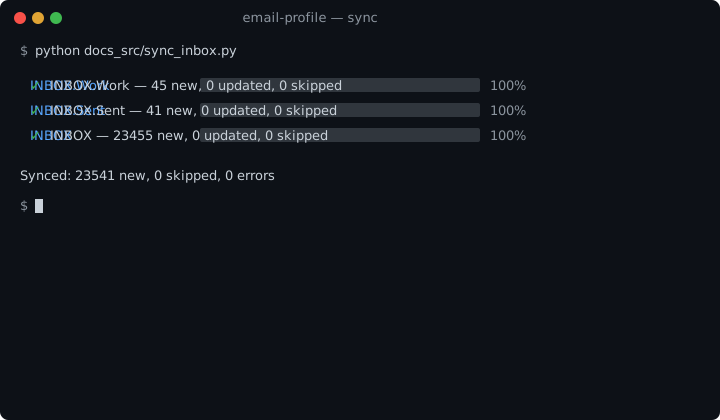
with Email.from_env() as app:
    # Built-in folder shortcuts (auto-detected across languages)
    app.inbox      # INBOX
    app.sent       # Sent / Enviados / Enviadas
    app.trash      # Trash / Lixeira / Papelera
    app.drafts     # Drafts / Rascunhos
    app.spam       # Spam / Junk / Lixo Eletrônico

    # Any folder by name
    work = app.mailbox("INBOX.Work")

    # Message operations
    work.mark_seen(uid)
    work.move(uid, "INBOX.Archive")
work.delete(uid)Storage is lazily initialized — email.db is only created when sync() or restore() is first called.
from email_profile import Email, StorageSQLite

# Default: saves to ./email.db on first sync
with Email.from_env() as app:
    app.sync()

# Custom path
with Email.from_env() as app:
    app.storage = StorageSQLite("./backup.db")
app.sync()| Feature | Description |
|---|---|
| Auto-discovery | Detects IMAP/SMTP servers from email domain (50+ providers) |
| Unified API | IMAP + SMTP in a single Email class |
| Query Builder | Composable search with Q (AND, OR, NOT) and validated Query kwargs |
| Sync & Restore | Incremental backup to SQLite, restore to any server |
| Parallel | Multi-threaded sync and restore with configurable workers |
| Progress | Rich progress bars with per-mailbox status |
| Retry | Exponential backoff on transient failures |
| Send | Send, reply, forward with HTML, attachments, CC/BCC |
| Storage | Pluggable storage backend (SQLite default) |
| Flags | Read/unread, flag, delete, move, copy operations |
| Context Manager | with Email(...) as app: for automatic cleanup |
Auto-discovery works out of the box. Just use your email and password — no server configuration needed.
| Provider | IMAP Server | |
|---|---|---|
 |
Gmail | imap.gmail.com |
 |
Outlook / Hotmail / Live | outlook.office365.com |
 |
Yahoo | imap.mail.yahoo.com |
 |
iCloud | imap.mail.me.com |
 |
Zoho | imap.zoho.com |
 |
ProtonMail (Bridge) | 127.0.0.1:1143 |
 |
AOL | imap.aol.com |
 |
Yandex | imap.yandex.com |
 |
Mail.ru | imap.mail.ru |
 |
GMX | imap.gmx.com |
 |
Hostinger | imap.hostinger.com |
 |
GoDaddy | imap.secureserver.net |
 |
Namecheap | mail.privateemail.com |
 |
Gandi | mail.gandi.net |
 |
OVH | ssl0.ovh.net |
 |
Ionos (1&1) | imap.ionos.com |
 |
Fastmail | imap.fastmail.com |
|
Rackspace | secure.emailsrvr.com |
|
Titan | imap.titan.email |
|
Locaweb | imap.locaweb.com.br |
|
KingHost | imap.kinghost.net |
|
UOL | imap.uol.com.br |
|
Terra | imap.terra.com.br |
Any server with DNS SRV or MX records is also detected automatically.
EMAIL_USERNAME=user@example.com
EMAIL_PASSWORD=app_password
EMAIL_SERVER=imap.example.com # optional, auto-discoveredMIT