named, repeatable app states for browser agents.
define signed-in, empty, error, and other hard-to-reach states once, then open them by url in a development build. your interface and feature code stay on their normal paths. the development composition replaces selected external systems with deterministic adapters. direct does not drive the browser or test those systems.
bun add --dev github:hraness/direct#v0.5.1real interface and feature state
│
product-owned port
┌───┴────┐
production direct
adapter harness
Copy this prompt into Codex, Claude Code, or another coding agent:
Install hraness/direct and its bundled Agent Skills from
https://github.com/hraness/direct at the immutable v0.5.1 tag. Follow the
repository README, add `@cclrte/direct` to devDependencies only, copy or link
`direct-setup` and `direct-verify` into this agent runner's configured
skills directory, and verify that the production dependency graph excludes
Direct. Do not add a fixture composition until I ask.
The tagged package and repository carry the same skill directories. Package installation leaves them inert until an agent places them in its runner-specific discovery path.
Pin the public repository to an immutable version tag:
{
  "devDependencies": {
    "@cclrte/direct": "github:hraness/direct#v0.5.1"
  }
}
Then install with Bun:
bun installKeep Direct in devDependencies. A production entry must not import Direct, its fixture worlds, or its workbench.
The packed package includes two Agent Skills under node_modules/@cclrte/direct/skills/. direct-setup guides a product-owned port, deterministic composition, and production-exclusion proof. direct-verify audits scenario behavior, quiescence, coverage claims, cleanup, and emitted production boundaries.
Agent runners do not share one discovery directory. Copy or link the desired skill directory into the location configured by your runner, then invoke $direct-setup or $direct-verify. Package installation leaves the skills inert: it does not run a postinstall hook or edit repository or user configuration.
Extract a strict world parser and product harness into product-owned files, then compose the lifecycle in one entry:
import { defineDirect } from "@cclrte/direct";
import { createDirectSession } from "@cclrte/direct/testing";
import { installDirectBrowser } from "@cclrte/direct/web";

import { parseGreetingWorld } from "./world.js";

const definition = defineDirect({
  parseWorld: parseGreetingWorld,
  defaultScenario: "greeting.ready",
  scenarios: [{
    id: "greeting.ready",
    title: "Ready greeting",
    route: "/",
    world: { version: 1, greeting: "Hello" },
  }],
  coverage: [{
    key: "greeting.render",
    mode: "fixture",
    claim: "The real greeting view renders a deterministic greeting.",
    scenarios: ["greeting.ready"],
  }],
});

const opened = createDirectSession({
  definition,
  activation: { kind: "query", source: globalThis.location.search },
  create: ({ world }) => Object.freeze({ greeting: world.greeting }),
});
if (!opened.ok) throw new Error(opened.error.message);

const session = opened.value;
const installed = installDirectBrowser({ session });
if (!installed.ok) {
  session.dispose();
  throw new Error(installed.error.message);
}

renderGreeting(session.harness.greeting);
globalThis.addEventListener("pagehide", session.dispose, { once: true });
defineDirect is the concise authored-config path; scenario defaults and coverage citations are checked against the same scenario tuple. Use tryDefineDirect for typed configuration assembled dynamically. Use parseDirectDefinition for a genuinely unknown value; it returns a Result with an intentionally broad JSON world and string route because foreign data cannot supply compile-time refinements.
One definition may contain at most 256 scenarios and 256 coverage entries.
The session supplies the parsed world, generation-safe store, logical clock,
activity scope, cancellation signal, world-free manifest, probe, coverage
value, and reverse-order cleanup. The browser installer publishes that
manifest with the live probe and reset action, blocks unmapped fetch calls
by default, rolls back partial installation, and registers teardown with
session.dispose().
An external browser tool reads window.__direct.schema,
window.__direct.manifest, and window.__direct.snapshot() in one synchronous
evaluation. Require the exact direct.browser-bridge/v2 schema, parse the
manifest and probe from unknown, confirm the expected activation source,
scenario, and product route, and require their activation hashes to match.
Retain one catalog hash across the run. Direct does not need a driver-specific
plugin: agent-browser, Playwright MCP, and other tools can read the same page
contract.
See the Todo example for a strict parser, product-owned port, React workbench, and emitted-graph boundary verifier. The React Native example uses the same session model in a platform-resolved Expo composition while keeping native production graphs Direct-free.
Coverage entries have one proof mode:
| Mode | Meaning |
|---|---|
fixture |
The real interface and product logic ran through deterministic ports. Replaced adapters and platforms were not exercised. |
mixed |
Fixture evidence is paired with named direct adapter or service evidence. Neither half is sufficient alone. |
direct |
The claim requires the real host, service, runtime, filesystem, operating system, or device. |
Coverage cites scenario IDs rather than duplicating a singular route. Each scenario owns its route, so one claim may span scenarios on different routes without inventing a second routing abstraction.
A quiet probe means the declared deterministic work settled. It does not prove that the rendered result is correct. Pair quiescence with product-owned semantic assertions, visual inspection where relevant, and direct tests for every replaced boundary named by the coverage catalog.
| Import | Purpose | Runtime boundary |
|---|---|---|
@cclrte/direct |
Authored definitions plus the scenario, coverage, fixture, JSON, activation, and logical-time types needed to describe them | Framework-free |
@cclrte/direct/core |
Advanced catalog, parser, store, runtime, effect, resource, ID, and Result mechanics |
Framework-free |
@cclrte/direct/react |
Typed context, provider, and external-store hooks for React DOM or React Native | Optional React peer |
@cclrte/direct/testing |
Sessions, manifest and probe parsers, evidence classification, activity scopes, and exact scripted transports | Development and verification |
@cclrte/direct/web |
Atomic browser installation, with low-level bridge and firewall escape hatches | Browser only |
The browser query boundary reserves:
__direct_scenario=<id>for a named catalog scenario.__direct_fixture=<encoded-json>for a portabledirect.fixture/v1envelope.
Malformed encoding, duplicate activation, unknown reserved keys, unknown scenarios, route mismatches, invalid worlds, and oversized input fail closed. An empty activation selects the definition's validated default scenario.
v0.5.0 replaces direct.browser-bridge/v1 with the exact v2 shape:
schema, manifest, snapshot(), and reset(). Coverage moved from
window.__direct.coverage to window.__direct.manifest.coverage. Low-level
bridge callers now pass manifest instead of coverage, and probe activation
hashes use fnv1a-64:<16 lowercase hexadecimal digits>. The manifest parser
also recomputes active.selectionHash, which binds the public source,
scenario, and route to that activation identity without exposing world or
runtime data.
Migrate the browser installation and each verifier together. Keep v0.4.0 pinned until a consumer can accept the complete v2 contract; do not support a hybrid bridge shape.
This repository contains the deterministic kernel, browser bridge, production-exclusion pattern, agent skills, a small React example, and an Expo/React Native reference app. It does not contain a browser driver, browser-worker pool, screenshot deduplication, video recording, PySceneDetect integration, or storyboard generation. Use the browser tooling that fits your product and treat recorded media as evidence, not as the definition of correctness.
Browser tools control a page. Direct makes the state behind it quick to reach and repeatable without claiming to test the external systems it replaces.
A browser agent can open a page, click a control, and inspect the result. It cannot make the state behind that page quick to reach. A signed-in account, a particular database record, a device permission, a model response, or a failure at the right moment may still take longer to arrange than the interface takes to review.
Hraness Direct separates those two jobs. A browser tool controls the page. The product connects Direct's named, repeatable states to its existing interface and feature logic through deterministic adapters below a small product-owned boundary. Direct speeds up development and review; it does not drive the browser or prove that replaced systems work.
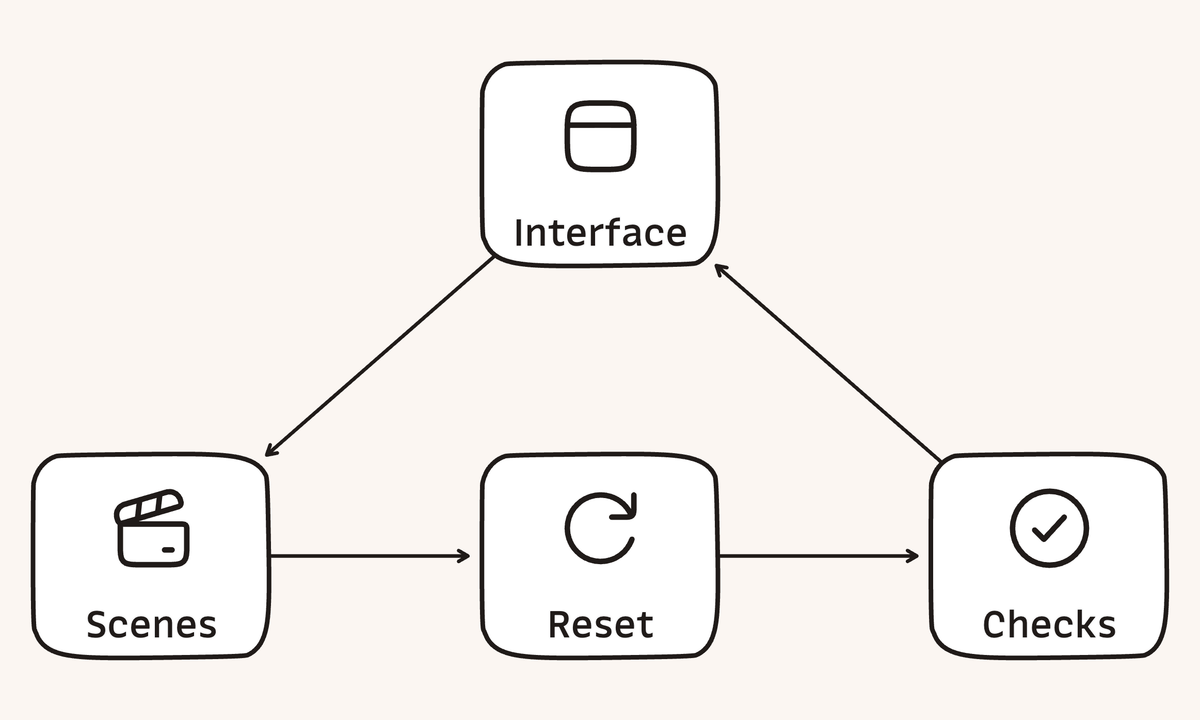
Hraness Direct keeps the interface while making scenes quick to reset and check.
agent-browser gives coding agents a compact command-line interface for opening pages, reading accessibility snapshots, and interacting with elements. Playwright and other browser drivers solve the same broad problem with different APIs. If the state you need is already fast and reliable to reach, a browser tool by itself is the smaller and better choice.
Direct becomes useful when setup dominates the loop: repeated sign-in, slow seed requests, hard-to-create empty or error states, unavailable native modules, paid model calls, or device permissions that automation cannot reset cleanly. Direct does not click the page. It gives the browser tool a stable page state to act on.
A product-owned port is a small interface between product behavior and an external system. A task view might ask a task repository to read and update tasks. Production connects that port to a live service. A Direct composition connects the same port to a deterministic implementation. The interface, reducers, parsing, navigation, and feature decisions above the port stay on their normal code paths.
The boundary can be pictured without knowing the package API:
Conceptual Direct boundary
agent-browser or Playwright
            │
   real interface + feature state
            │
     product-owned port
        ┌───┴────┐
  live system   Direct world
A Direct world is validated JSON that describes one starting state. A scenario gives that world a name and route. It does not contain browser actions. The browser check still decides what to click and what outcome to assert.
The public Todo example uses one TodoPort in both compositions. The component receives whichever implementation the entry point owns:
One product port, two compositions
export interface TodoPort {
  readTodos(): Promise<readonly TodoItem[]>;
  setCompleted(id: string, completed: boolean):
    Promise<readonly TodoItem[]>;
}

const port = isDirect
  ? createDeterministicTodoPort(world)
  : createLiveTodoPort();

<TodoApp port={port} />
The interface speaks in product terms: todos and completion. It contains no Direct types and does not know whether storage is live or deterministic. Use the lowest port that preserves the behavior under review. If the Direct adapter must copy the logic named by the claim, the boundary is too high and the fixture would imitate its subject instead of testing it.
Direct gives the development composition one lifecycle instead of a collection of unrelated fixture helpers:
- A definition validates the named worlds, routes, and evidence claims.
- A session activates one world and owns its state, logical time, tracked work, reset generation, and cleanup.
- A browser installation publishes the scenario catalog, active-state identity, coverage contract, probe, and reset action while blocking unmapped application requests by default.
That default network policy matters. A deterministic page should not silently call a live service when a fixture misses a case. The product can allow exact URLs when needed, but unknown application calls fail visibly. Direct and its fixture worlds also stay outside the production dependency graph.
The published manifest makes the page self-describing. An agent can discover valid scenario IDs and routes, confirm which activation the current probe belongs to, and check that it is the requested scenario and route without reading a product-specific source file. The browser tool still owns navigation and interaction; Direct does not turn scenarios into commands.
A fixed delay says, “wait 500 milliseconds and hope.” Direct exposes a quiescence snapshot: no tracked operation is active, and each product-named pending counter is zero. The product's browser verifier must poll that snapshot until its generation, revision, and counters remain stable for a bounded interval before checking the interface.
Browser check using a named Direct scenario
await page.goto(
  "/direct/?__direct_scenario=todos.populated",
);
await waitForQuiescence(page);

await page.getByRole("checkbox", {
  name: "Write the public guide",
}).check();

await waitForQuiescence(page);
await expect(page.getByRole("checkbox", {
  name: "Write the public guide",
})).toBeChecked();
Here, waitForQuiescence is product-owned verifier code around Direct's snapshot, not a Direct browser driver. Quiescence proves only that the work Direct knows about has settled. It does not prove that the screen is correct. The verifier must still reject relevant console, runtime, and unhandled-request errors, then make product-specific assertions or visual checks.
- Use browser automation alone when the required state is already quick to reach, or when the live backend and browser assembly are part of the check.
- Pair Direct with agent-browser or Playwright when setup and reset dominate the loop and the substituted systems can sit behind a small product-owned port.
- Use unit or component tests when the subject is isolated logic or rendering that does not need the full application composition.
- Keep live integration and end-to-end tests when the backend, native host, browser assembly, filesystem, operating system, or device is the subject.
Direct records the same distinction in coverage claims. A fixture claim stops at deterministic ports. A mixed claim combines fixture evidence with a named live check. A direct claim requires the real system. The labels do not create evidence; they keep a fast development check from being reported as proof of a system it never touched.
The package includes two Agent Skills under skills/. direct-setup guides the product-port boundary, deterministic composition, and production-exclusion check. direct-verify guides scenario review, quiescence, cleanup, and evidence classification. The skills carry the technical detail an agent needs without forcing every human reader through an API manual.
Package installation leaves the skills inactive because coding-agent runners use different discovery directories. Copy or link the desired skill into the runner's configured location, then invoke it by name. The package does not run a postinstall script or edit agent configuration.
Use Direct when the state behind the interface is the bottleneck and a small product-owned port can replace that setup without copying the behavior under review. Use the browser tool alone when it can already reach the state cheaply. In either case, the browser driver supplies the actions and assertions. Direct never exercises the systems behind replaced ports; cover those boundaries separately with live integration or end-to-end tests when their risk requires it.
bun install --frozen-lockfile --ignore-scripts
bun run check
bun run example:test
bun run example:typecheck
bun run example:verify
bun run example:build
bun run example:check-boundary
bun run example:build:direct
bun run example:react-native:test
bun run example:react-native:typecheck
bun run example:react-native:verify
Run the production app with bun run example:dev. Run the deterministic workbench with bun run example:direct, then select empty, populated, or write failure from its scenario navigation.
Run the Expo workbench with bun run example:react-native. Its verification command exports iOS and Android production bundles plus the deterministic React Native Web composition with paired source maps, proves the expected shared and platform-specific modules were selected, and rejects native/web cross-contamination. It does not replace browser-driven semantic assertions or direct device evidence.
See Architecture, Adoption, Verification, and Wire formats for durable contracts.
Read CONTRIBUTING.md before opening a pull request. Report suspected vulnerabilities privately as described in SECURITY.md.
Direct is available under the MIT License.