Push Pull notifications must not be used with any OFFICIAL, OFFICIAL SENSITIVE, SECRET or TOP SECRET information.
This API allows notifications to be sent (pushed) to software developers or allows the software developer to get (pull) notifications. Notifications are created by other HMRC services.
An example use case is for asynchronous API requests:
- API X defines an api-subscription-field of type PPNS (see https://confluence.tools.tax.service.gov.uk/pages/viewpage.action?pageId=182540862)
- Software developer subscribes to API X in Developer Hub and can optionally add an endpoint where notifications
will be pushed to. This automatically creates a PPNS box called [API_CONTEXT]##[API_VERSION]##[API_SUBSCRIPTION_FIELD_NAME]
, Eg
hello/world##1.0##callbackUrl - Software developer makes an API request to API X
- API X gets the client ID from either the
X-Client-Idheader or from an auth retrieval. - API X makes a request to
GET /boxusing the inferred box name and client ID to retrieve the box ID. - API X generates a correlation/request ID.
- API X sends a response 200 HTTP status to the software developer with a body containing the box ID and the correlation/request ID.
- API X starts their asynchronous process, saving the state of this with the correlation/request ID and PPNS box ID.
- API X complete their asynchronous process, retrieving correlation/request ID and PPNS box ID from state.
- API X creates a message which must contain the correlation/request ID, and POSTs it to PPNS using the box ID.
- If the software developer has set the api-subscription-field, the notification is POSTed to their endpoint
- The API consumer receives the notification and matches the correlation/request ID in the notification with the correlation/request ID they got from the initial API request, they extract the message and process it accordingly.
- If the API consumer chooses to call the PPNS get-notifications endpoint using the box ID, they can retrieve a
list of notifications.
- The API consumer iterates over each notification and matches the correlation/request ID in the notification with the correlation/request ID they got from the initial API request, they extract the message and process it accordingly.
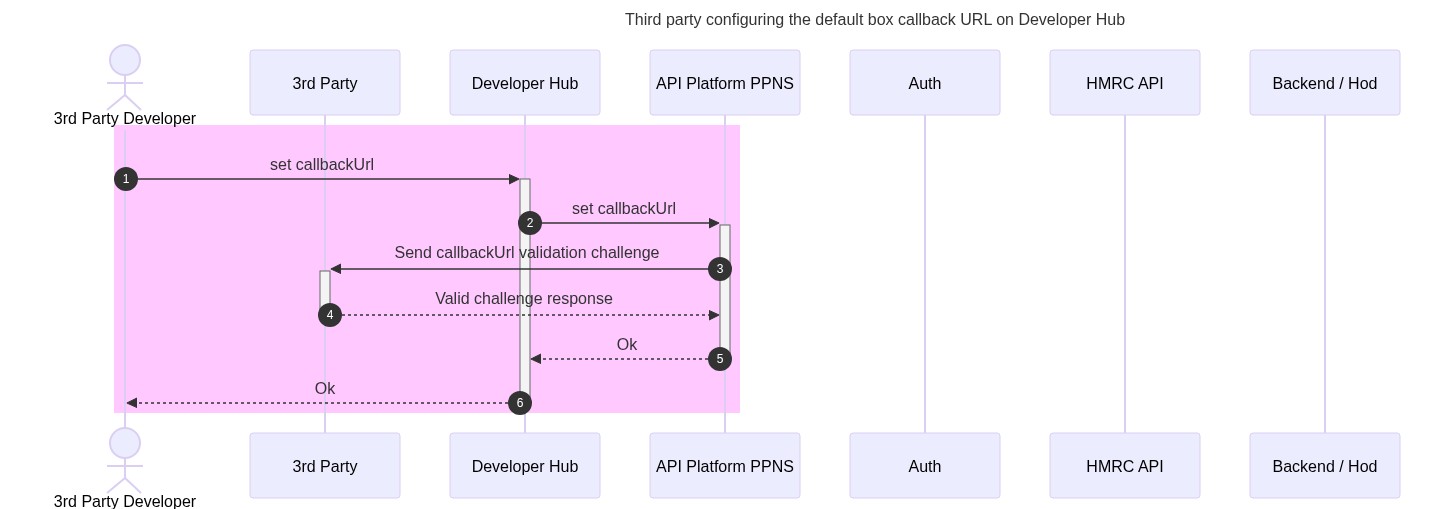
The details on the validation of the callbackURL with the 3rd party are documented here: External Push Pull Notifications API


| Term | Description |
|---|---|
| box | A container for notifications |
| notification | A wrapper for a message. Notifications expire after 30 days |
| message | XML or JSON that is being communicated from an API producer to an API consumer |
| default box | the default box created automatically per application and API version subscription |
Return the details of a box
| Name | Description |
|---|---|
boxName (optional) |
The name of the box to get. URL encoded. For example BOX%202 |
clientId (optional) |
The Developer Hub Client ID that owns the box |
HTTP Status: 200
{
    "boxId": "1c5b9365-18a6-55a5-99c9-83a091ac7f26",
    "boxName":"BOX 2",
    "boxCreator":{
        "clientId": "X5ZasuQLH0xqKooV_IEw6yjQNfEa"
    },
    "subscriber": {
        "subscribedDateTime": "2020-06-01T10:27:33.613+0000",
        "callBackUrl": "https://www.example.com/callback",
        "subscriptionType": "API_PUSH_SUBSCRIBER",
    }
}
| Name | Description |
|---|---|
boxId |
Identifier for a box |
boxName |
Box name |
boxCreator.clientId |
Developer Hub Application Client ID, that created and has access to this box |
subscriber |
Details of the subscriber to this box |
subscriber.subscribedDateTime |
ISO-8601 UTC date and time that the subscription was created |
subscriber.callBackUrl |
The URL of the endpoint where push notifications will be sent |
subscriber.subscriptionType |
The type of subscriber. Currently only API_PUSH_SUBSCRIBER is supported |
| Scenario | HTTP Status | Code |
|---|---|---|
| Missing or incorrect query parameter | 400 |
BAD_REQUEST |
| Box does not exist | 404 |
BOX_NOT_FOUND |
Create a new box
This endpoint is restricted, only a allowlist of services can access it.
| Name | Description |
|---|---|
Content-Type |
Either application/json or text/json |
User-Agent |
User agent that identifies the calling service |
{
    "boxName": "Box 1",
    "clientId": "X5ZasuQLH0xqKooV_IEw6yjQNfEa"
}
| Name | Description |
|---|---|
boxName |
The name of the box to create |
clientId |
The Developer Hub Client ID that can access this box |
HTTP Status: 201 if the box is created
{
    "boxId": "1c5b9365-18a6-55a5-99c9-83a091ac7f26"
}
HTTP Status: 200 if the box already exists
{
    "boxId": "1c5b9365-18a6-55a5-99c9-83a091ac7f26"
}
| Scenario | HTTP Status | Code |
|---|---|---|
boxName or clientId missing from request body |
400 |
INVALID_REQUEST_PAYLOAD |
| Access denied, service is not allowlisted | 403 |
FORBIDDEN |
Set the Callback URL for a box. This defines the endpoint on the third party's system that push notifications will be sent to.
Attempting to update the Callback URL triggers PPNS to perform a validation of the supplied endpoint. The third party's system must respond correctly before the Callback URL is updated.
| Name | Description |
|---|---|
boxId |
Unique identifier for a box. Eg 1c5b9365-18a6-55a5-99c9-83a091ac7f26 |
| Name | Description |
|---|---|
Content-type |
Must be application/json |
User-Agent |
User agent that identifies the calling service |
{
    "clientId": "838e5276-b9d7-4258-a018-ea5cb54f39a1",
    "callbackUrl": "https://www.example.com/callback"
}
| Name | Description |
|---|---|
clientId |
The Developer Hub Client ID that owns the box |
callbackUrl |
The URL of the endpoint where push notifications will be sent |
HTTP Status: 200
{
    "successful": "true"
}
| Name | Description |
|---|---|
successful |
Whether the Callback URL was updated successfully or not |
In addition to the successful response above, it is also currently possible to receive a 200 response in other
scenarios where the Callback URL has not been updated. In these cases the response will look like the following:
    "successful": "false",
    "errorMessage": "Reason for failure"
The scenarios where this can occur are as follows:
- PPNS has been unable to validate the Callback URL on the client's system
- PPNS has been unable to update the Callback URL internally
| Scenario | HTTP Status | Code |
|---|---|---|
| Box ID is not a UUID | 400 |
BAD_REQUEST |
clientId or callBackUrl is missing or invalid in request body |
400 |
INVALID_REQUEST_PAYLOAD |
Supplied clientId does not match that associated with box |
401 |
UNAUTHORIZED |
| Box does not exist | 404 |
BOX_NOT_FOUND |
Create a notification
This endpoint is restricted, only a allowlist of services can access it.
N.B. Maximum payload (request body) size currently supported is 100K.
| Name | Description |
|---|---|
boxId |
Unique identifier for a box. Eg 1c5b9365-18a6-55a5-99c9-83a091ac7f26 |
| Name | Description |
|---|---|
Content-Type |
Either application/json or application/xml |
User-Agent |
User agent that identifies the calling service |
The request body can be any JSON or XML (must match the Content-type header). The request body is the notification
message that can be retrieved.
Example 1:
{
    "foo": "bar",
}
Example 2:
<foo>bar</foo>
HTTP Status: 201
{
    "notificationId": "1c5b9365-18a6-55a5-99c9-83a091ac7f26"
}
| Scenario | HTTP Status | Code |
|---|---|---|
| Box ID is not a UUID | 400 |
BAD_REQUEST |
| Request body does not match the Content-Type header | 400 |
INVALID_REQUEST_PAYLOAD |
| Access denied, service is not allowlisted | 403 |
FORBIDDEN |
| Box does not exist | 404 |
BOX_NOT_FOUND |
| Request is too large | 413 |
This endpoint is exposed through the API Platform see documentation on https://developer.qa.tax.service.gov.uk/
Get a list of notifications that have been sent to a box
| Name | Description |
|---|---|
boxId |
Unique identifier for a box. Eg 1c5b9365-18a6-55a5-99c9-83a091ac7f26 |
| Name | Description |
|---|---|
status (optional) |
Only return notifications with this status. One of PENDING, FAILED or ACKNOWLEDGED |
fromDate (optional) |
Only return notifications created after this UTC datetime. ISO-8601 format. Eg 2020-06-03T14:20:54.987 |
toDate (optional) |
Only return notifications created before this UTC datetime. ISO-8601 format. Eg 2020-06-03T14:20:54.123 |
| Name | Description |
|---|---|
Authorization |
A valid auth bearer token |
Accept |
Standard API Platform Accept header. application/vnd.hmrc.1.0+json |
HTTP Status: 200
[
    {
        "notificationId":"4e57c65a-f687-442c-b695-f635d5d2e856",
        "boxId":"7fe732c9-af27-4a94-973d-5c60d0a133d8",
        "messageContentType":"application/json",
        "message":"{\"test\": \"hello\"}",
        "status":"ACKNOWLEDGED",
        "createdDateTime":"2020-06-03T14:14:54.108+0000"
    },
    {
        "notificationId":"583b6394-49ea-4a8e-8d66-c3a8f4b920a3",
        "boxId":"7fe732c9-af27-4a94-973d-5c60d0a133d8",
        "messageContentType":"application/xml",
        "message":"<root>XXX</root>",
        "status":"PENDING",
        "createdDateTime":"2020-06-03T14:29:10.049+0000"
    }
]
| Name | Description |
|---|---|
notificationId |
Unique identifier for a notification |
boxId |
Unique identified for a box that the notification was sent to |
messageContentType |
Content type of the message, either application/json or application/xml |
message |
The notification message. JSON or XML as defined by messageContentType. If this is JSON then it will have been escaped. For details about the structure of this data consult the documentation for the HMRC API that created the notification |
status |
Status of the notification. PENDING, ACKNOWLEDGED, FAILED |
createdDateTime |
ISO-8601 UTC date and time that the notification was created |
| Scenario | HTTP Status | Code |
|---|---|---|
| Box ID is not a UUID | 400 |
BAD_REQUEST |
| Query parameters are invalid | 400 |
INVALID_REQUEST_PAYLOAD |
| Access denied, The Developer Hub Client ID in the auth bearer token does not have access to this box | 403 |
FORBIDDEN |
| Box does not exist | 404 |
BOX_NOT_FOUND |
| The accept header is missing or invalid | 406 |
ACCEPT_HEADER_INVALID |
If you need to call any of the endpoints exposed over the API Platform, you need to pass in an valid authorisation header for the application restricted endpoints:
- Get an API Platform bearer token
curl --location --request POST 'http://localhost:9613/token' \
--header 'content-type: application/x-www-form-urlencoded' \
--data-urlencode 'client_secret=???????' \
--data-urlencode 'client_id=????????' \
--data-urlencode 'grant_type=client_credentials'
(Replacing the client_id & client_secret with ones from you local setup)
- Get the internal auth header from the API platform's external bearer token:
 mongo localhost/third-party-delegated-authority --eval "db.delegatedAuthority.find({
    'token.accessToken' : '???????'
 },{
     _id: 0,
     internalAuthHeader: 1
 })"
(Replacing the accessToken with the one obtained in step 1)
- You can then call application restricted endpoints in the PPNS API:
curl --location --request GET 'http://localhost:6701/box/{box-id}/notifications' \
--header 'Content-Type: application/json' \
--header 'Accept: application/vnd.hmrc.1.0+json' \
--header 'Authorization: ??????????'
(Replacing the box-id with a valid local box-id and the Authorization: with the internal authorisation header obtained in step 2)
If you fail to find an internalAuthHeader from step 2 this will probably be because the delegated authority was created prior to One Login for Government. In this case search instead for the authBearerToken.
 mongo localhost/third-party-delegated-authority --eval "db.delegatedAuthority.find({
    'token.accessToken' : '???????'
 },{
     _id: 0,
     authBearerToken: 1
 })"
(Replacing the accessToken with the one obtained in step 1)
Use this in the authorisation header of step 3 prefixed with the word Bearer
... as above ...
--header 'Authorization: Bearer ??????????'
This code is open source software licensed under the Apache 2.0 License.