Your coding agent gets worse as its context fills.
contextrot proves it on your own sessions — and tells you exactly what to change.


uvx contextrotor, with plain pip (Python 3.9+ — including the stock python3 on macOS):
pip3 install contextrot
contextrot
contextrot: command not foundafter pip install? Your Python scripts directory isn't onPATH(common with the stock macOSpython3). Either useuvx contextrotabove, or run it PATH-free withpython3 -m contextrot.
That's it. No config, no API keys, no uploads. contextrot reads the session transcripts your agent CLI already keeps on disk and answers a question no other tool answers:
At what context fill does my agent start failing, what's causing it, and what is it costing me?
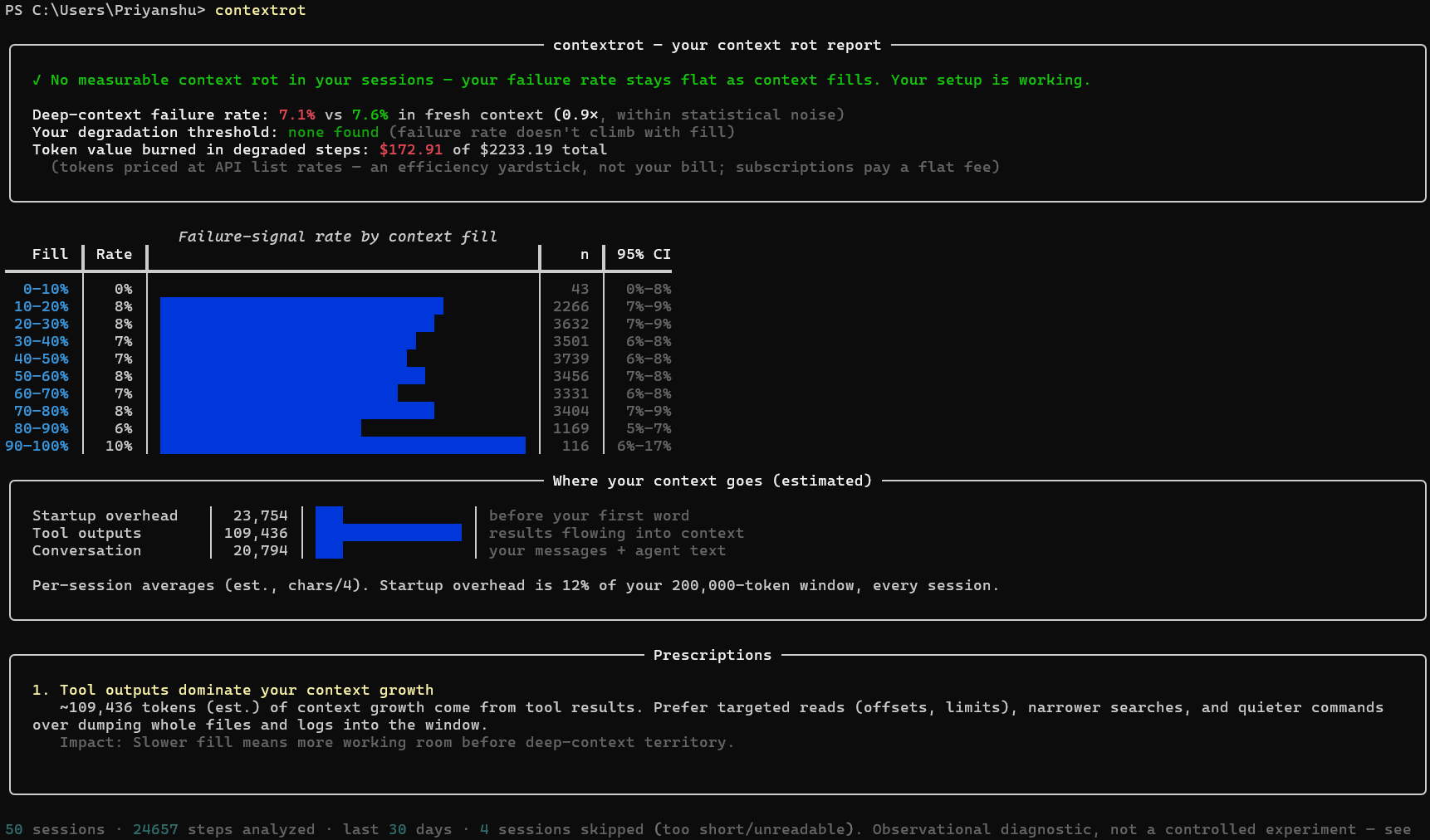
Every report leads with a plain verdict — one of four honest answers:
| Verdict | Meaning |
|---|---|
| ✗ Context rot detected | your failure rate climbs significantly as context fills |
| ! Edge rot | flat until near the window limit, then it climbs — compact before you get there |
| ✓ No measurable rot | your failure rate stays flat; your setup is working |
| ? Not enough data | keep using your agent and re-run |
A tool that can say "you're fine" is a tool you can trust when it says you're not.
Research (Chroma's context-rot report, several 2026 papers) shows LLM output quality degrades as input context grows — even far below the window limit. But that research runs synthetic tasks in lab conditions. Your degradation point depends on your projects, your MCP setup, your model, your prompting style.
contextrot measures it where it actually matters: in your own sessions.
Agent CLIs like Claude Code log every session to local JSONL transcripts. Each step carries token accounting and behavioral evidence. contextrot extracts five independent failure signals per step and correlates them with context fill at that moment:
| Signal | What it catches |
|---|---|
| Edit failures | the agent tried to edit code and missed — the clearest "lost track of file state" event |
| Retry loops | the same tool call repeated after an error: paying twice for one action |
| Re-reads | re-reading files it already read — content scrolled out of effective attention |
| Self-corrections | "I apologize, let me fix that" |
| Tool errors | any failed tool call |
Statistics are kept honest: Wilson 95% confidence intervals, per-signal breakdowns, visible n-counts, and a degradation threshold that only gets declared when a bucket's confidence floor clears the baseline — one noisy bucket can't scare you. Full method: docs/methodology.md.
Use more than one model? The report also compares them head-to-head — an independent rot curve and verdict per model family (Opus vs Sonnet vs Haiku), on a shared scale, so you can see which model degrades first for your workload.
contextrot                      # full report, last 30 days
contextrot --days 90            # more history = tighter statistics
contextrot -p myproject         # one project only
contextrot --html report.html   # shareable single-file report (still 100% local)
                                #   includes a 1200×630 share card — save as PNG,
                                #   post it; and a per-model comparison when you
                                #   use more than one model
contextrot --json               # every number, recomputable
contextrot sessions # list what was parsed| Tool | Question it answers | What it can't tell you |
|---|---|---|
| ccusage | "How much did I spend?" | anything about output quality — use both, they're complementary |
Claude Code /context |
"What's in my window right now?" | no outcomes, no history, no correlation |
| Langfuse / Phoenix / MLflow | "How is the app I built behaving?" | require instrumentation; contextrot analyzes the agent you use, zero setup |
| Chroma's research | "Do models degrade on benchmarks?" | nothing about your workload — contextrot is the personal-data counterpart |
The report says $2,000+ but I'm on a $20/month subscription. Is it broken? No — that figure is the token value of your usage priced at API list rates, labeled as such in the report. It exists because tokens are the resource that fills your context window and burns your rate limits, and dollars are the only unit everyone reads instantly. Two honest readings: it's what your usage would cost pay-per-token (enjoy your subscription), and the "burned in degraded steps" share is the fraction of that resource going to rework. It is not, and never claims to be, your bill.
Why is the token flow so large? Agents re-send the entire conversation to the model on every step. A 100-step session at 100k context ≈ 10M tokens flowing through — mostly cache reads. That's normal; it's also exactly why context bloat matters.
Correlation isn't causation, right? Right, and the report says so on its face. Deep-context steps are also later-in-task steps. contextrot is an observational diagnostic with conservative statistics, not a lab experiment — see methodology.
What about my privacy? contextrot makes zero network calls. Local files in, terminal/local HTML out. Grep the codebase for an HTTP client — there isn't one.
| Agent | Status |
|---|---|
| Claude Code | ✅ today |
| OpenCode | ✅ today — community-contributed |
| Codex CLI | adapter wanted — spec'd and ready to pick up |
| Gemini CLI | adapter wanted — spec'd and ready to pick up |
| OpenTelemetry GenAI spans | planned |
An adapter is one small file with a fixture and a test — it's the paved first-contribution path.
contextrot fix— apply prescriptions interactively (disable unused MCP servers, trim CLAUDE.md) with before/after measurement- More agent adapters + OTel ingestion
- Opt-in, anonymized aggregate stats → the State of Context Rot report: real-workload degradation curves across the community (off by default, aggregate-only, documented schema)
See CONTRIBUTING.md. Most valuable first PR: an adapter for the agent CLI you use — there are spec'd, ready-to-pick-up adapter issues waiting.


Live dashboards: pypistats · clickpy (ClickHouse)
If contextrot told you something useful about your setup, a ⭐ helps other agent users find it.