Important
Status: Research infrastructure, not a required part of the product. This package is evaluation and benchmarking tooling for GUI agents and for the OpenAdapt demonstration compiler. It is evidence-generating research work. It is not required to record, compile, or replay a workflow, and no end user needs it installed.
The OpenAdapt product is the governed demonstration compiler,
openadapt-flow, installed
via the OpenAdapt launcher
(pip install openadapt). It compiles a demonstrated GUI workflow into a
deterministic, locally executable program. Healthy runs make no model calls,
and it halts instead of guessing when verification fails. Lifecycle labels for
every repository are in the
repository lifecycle registry.


Evaluation and benchmarking infrastructure for GUI agents and for OpenAdapt, the governed demonstration compiler. Documentation for the wider project lives at docs.openadapt.ai.
OpenAdapt Evals produces the evidence behind OpenAdapt's claims. It runs GUI agents and compiled OpenAdapt workflows against standardized benchmarks (today, Windows Agent Arena (WAA)), provisions and manages the cloud VMs those benchmarks need, and accounts for the dimensions that matter to a governed compiler:
- Compiled replay vs zero-shot agent on the same tasks, scored by each benchmark's own verifier rather than by the policy's self-report.
- Silent wrong-action rate: how often a run writes an incorrect state without signalling failure.
- Over-halt rate: how often a run halts when it should have proceeded.
- Cost and model-call accounting: model calls, latency, and dollar cost per successful task, including the ~0-model-call healthy replay path.
This is internal research tooling. It is not a packaged end-user product and it
is not needed to use OpenAdapt. If you want to record, compile, and replay a
workflow, use the OpenAdapt
launcher, not this repository.
OpenAdapt is a governed demonstration compiler: record once, compile, then replay deterministically with zero model calls on the healthy path, halting instead of guessing when verification fails. All execution substrates (web, Windows, macOS, Linux, RDP, and Citrix/VDI) are first-class in the product. This repository is where those substrates get measured. Its primary target today is the Windows substrate via WAA, because WAA gives an independent, reproducible verifier for real desktop tasks. Substrate maturity across the product is tracked honestly in the OpenAdapt docs; this repo does not claim maturity it has not measured.

More screenshots
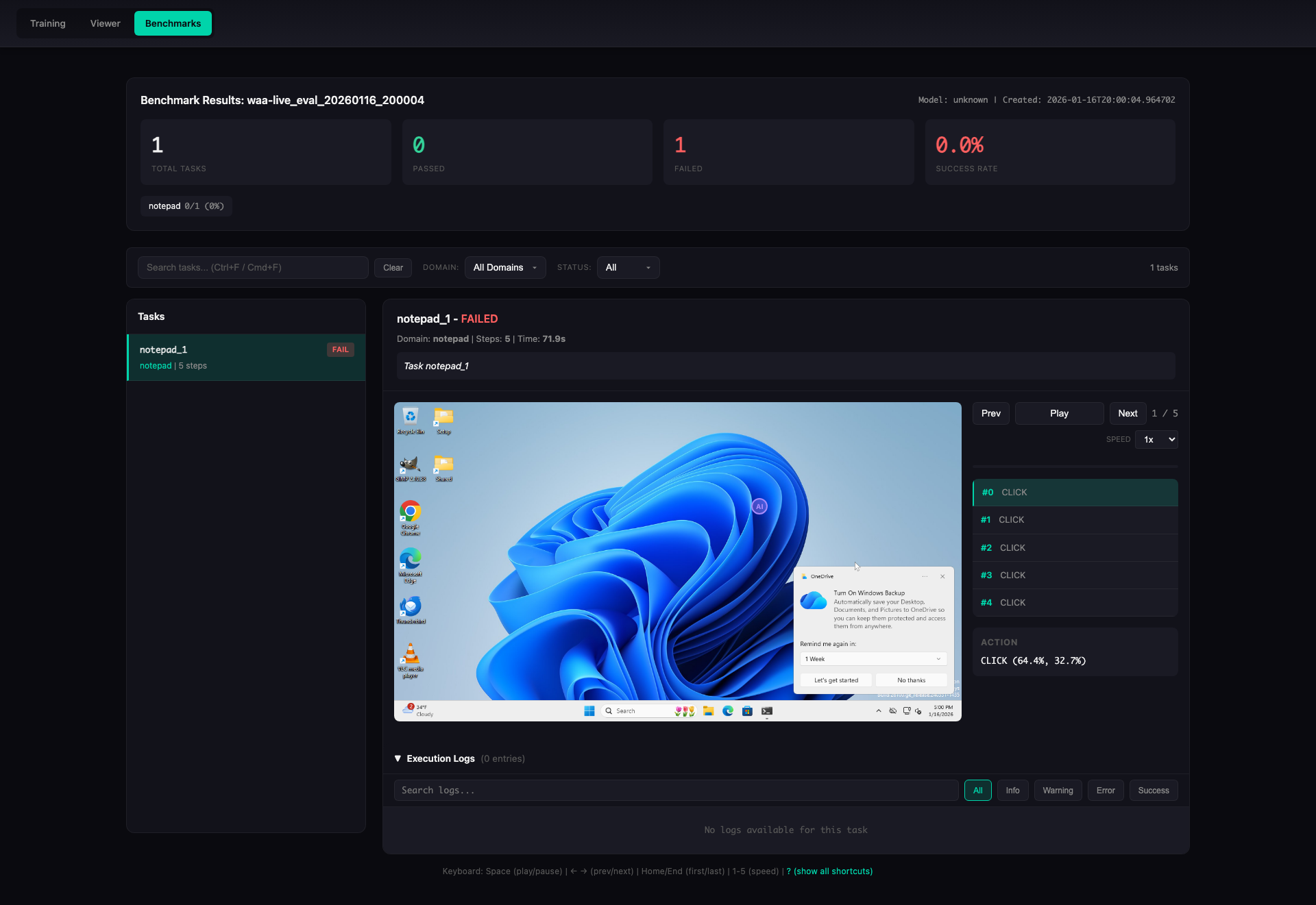
Task Detail View (step-by-step replay with screenshots, actions, and execution logs):
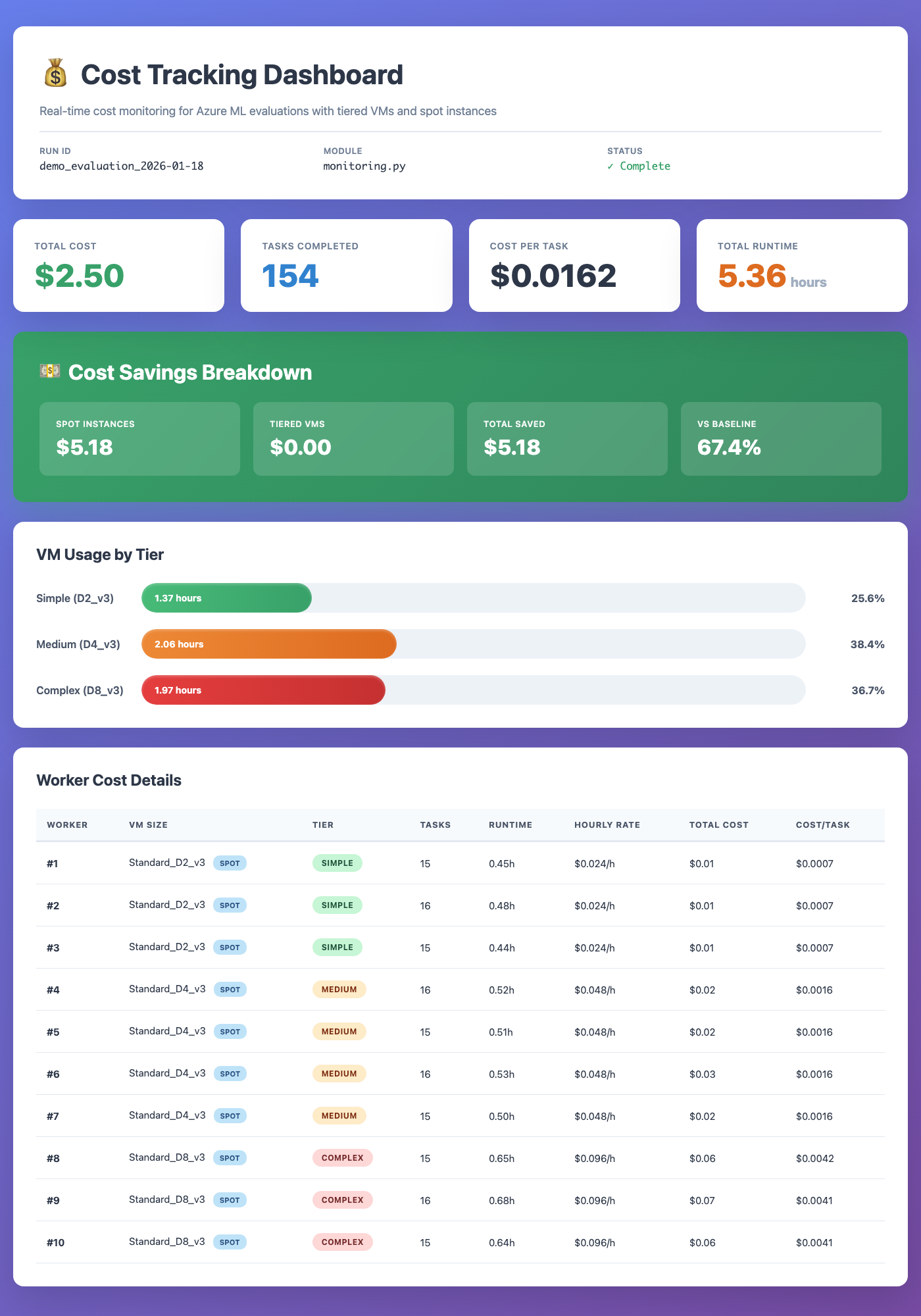
Cost Tracking Dashboard (real-time VM cost monitoring with tiered sizing and spot instances):
- openadapt-flow evaluation (
openadapt_evals/flow/): the paradigm-correct eval for a demonstration compiler. Areplayrunner compiles one demonstration into an openadapt-flow bundle and replays it against the WAA in-guest server with roughly zero model calls, and ahybridagent runs compiled replay first with a computer-use fallback only on a detected halt. Both are scored by WAA's own task verifier. Driven byscripts/eval_flow_on_waa.py, which is dry-run by default and hard cost-capped (see below). - Meta-benchmark harness (
openadapt_evals/harness/): one driver that runs the record, compile, replay, heal, verify loop across any registeredEnvironmentand emits one metrics row per(env, task, mode). Success is the environment's own verifier verdict, never the policy's self-report. Includes an export path to Inspect AI format. - Benchmark adapters (
openadapt_evals/adapters/): WAA live and mock adapters, aLocalAdapterfor native desktop runs with no VM, aScrubMiddlewarewrapper that removes PII before the agent sees a screenshot, and a verl-compatible environment wrapper. TheBenchmarkAdapterbase is designed to extend to other benchmarks such as OSWorld or WebArena; only WAA and local are implemented today. - Agent interfaces (
openadapt_evals/agents/):PlannerGrounderAgent(dual-model, "what to do" separated from "where to click"),ApiAgent(Claude or GPT with demo persistence),DemoGuidedAgent,DemoExecutor(tiered deterministic replay),RetrievalAugmentedAgent,ClaudeComputerUseAgent, andPolicyAgentfor trained models. - Cloud VM infrastructure (
openadapt_evals/infrastructure/): Azure and AWS VM managers behind oneVMProviderprotocol, aPoolManagerfor parallel evaluation, SSH tunnel management, a monitoring dashboard, and cost tracking. - RL training infrastructure (
openadapt_evals/training/,openenv/): a standalone GRPO trainer with zero openadapt-ml dependency, a TRLGRPOTrainerrollout function, an AReaL workflow wrapper, an OpenEnv-compatible environment, and trajectory logging and caching utilities. This is research-stage. - Workflow extraction pipeline (
openadapt_evals/workflow/): a four-pass pipeline (scrub, transcript, extract, match) for turning desktop recordings into structured workflows. - Analysis and evidence (
openadapt_evals/analysis/,eval_results/): trace analysis, report generation, and committed performance reports produced byscripts/report_openadapt_performance.pyandscripts/run_current_flow_local_benchmark.py. - CLI tooling: a
oaVM lifecycle CLI, anoa-vmpool CLI, and anopenadapt-evalsbenchmark CLI (see CLI Reference).
pip install openadapt-evalsWith optional dependencies:
pip install openadapt-evals[training]   # GRPO trainer + Outlines constrained decoding
pip install openadapt-evals[azure]      # Azure VM management
pip install openadapt-evals[aws]        # AWS EC2 management
pip install openadapt-evals[retrieval]  # Demo retrieval agent
pip install openadapt-evals[viewer]     # Live results viewer
pip install openadapt-evals[all]        # Everything
For development, clone the repo and use uv:
git clone https://github.com/OpenAdaptAI/openadapt-evals.git
cd openadapt-evals
uv sync --extra dev
uv run pytest tests/ -vopenadapt-evals mock --tasks 10# Start a single VM (Azure by default)
oa-vm pool-create --workers 1
oa-vm pool-wait
# Or use AWS
oa-vm pool-create --cloud aws --workers 1
oa-vm pool-wait --cloud aws
# Run evaluation
openadapt-evals run --agent api-claude --task notepad_1
# View results
openadapt-evals view --run-name live_eval
# Clean up (stop billing)
oa-vm pool-cleanup -yfrom openadapt_evals import (
ApiAgent,
WAALiveAdapter,
WAALiveConfig,
evaluate_agent_on_benchmark,
compute_metrics,
)
adapter = WAALiveAdapter(WAALiveConfig(server_url="http://localhost:5001"))
agent = ApiAgent(provider="anthropic")
results = evaluate_agent_on_benchmark(agent, adapter, task_ids=["notepad_1"])
metrics = compute_metrics(results)
print(f"Success rate: {metrics['success_rate']:.1%}")This is the point of the repository: measuring the demonstration compiler, not
just generic agents. scripts/eval_flow_on_waa.py runs openadapt-flow against
WAA in two modes, both scored by WAA's own verifier.
- replay: compile one demonstration into a bundle, then replay it via the Windows backend against the WAA in-guest server with roughly zero model calls. This is the paradigm-correct eval for a compiler.
- hybrid: compiled replay first, with a computer-use agent fallback only on a detected halt. Directly comparable to a pure agent baseline on the same tasks.
Safety. This command is dry-run by default. It never provisions Azure, never
starts a VM, and makes no network calls unless you pass --live, which also
requires a reachable WAA server and stays under hard cost caps. A prior uncapped
run was expensive, which is why the caps are mandatory.
# Cost estimate and plan for a 10-task and a full (154) replay run (no network):
python scripts/eval_flow_on_waa.py --mode replay --tasks 10 --dry-run
python scripts/eval_flow_on_waa.py --mode replay --tasks 154 --dry-run

# Hybrid dry-run assuming a 30% halt/fallback rate:
python scripts/eval_flow_on_waa.py --mode hybrid --tasks 154 --fallback-rate 0.3 --dry-run

# Live run (gated: needs Azure, a revived waa-pool, and maintainer go-ahead):
python scripts/eval_flow_on_waa.py --mode replay --task-ids <id1>,<id2> \
    --bundles ./flow_bundles --server-url http://localhost:5001 --live
The openadapt-eval-flow console entry point wraps the same script.
Bounded, reproducible performance reports are committed under eval_results/
and generated by scripts/report_openadapt_performance.py and
scripts/run_current_flow_local_benchmark.py, each with an accompanying
markdown summary. These reports are the source for public performance claims and
are intended to be regenerable. Deployment-derived thresholds, tuned adversary
parameters, per-system-of-record oracle recipes, and real customer datasets are
not part of this open repository.
Record demos on a remote VM via VNC, annotate with a VLM, then run demo-conditioned eval:
# 1. Pre-flight check: verify all required apps are installed
python scripts/record_waa_demos.py record-waa \
  --tasks 04d9aeaf,0a0faba3 --server http://localhost:5001 --verify

# 2. Record demos interactively (perform actions on VNC, press Enter after each step)
python scripts/record_waa_demos.py record-waa \
  --tasks 04d9aeaf,0a0faba3 --server http://localhost:5001 --output waa_recordings/

# 3. Annotate recordings with a VLM
python scripts/record_waa_demos.py annotate \
  --recordings waa_recordings/ --output annotated_demos/ --provider openai

# 4. Run demo-conditioned eval
python scripts/record_waa_demos.py eval \
--demo_dir annotated_demos/ --tasks 04d9aeaf,0a0faba3scripts/run_full_eval.py is a production-grade runner with resume support,
per-task error isolation, health checks with exponential backoff, and parallel
pool execution:
# List tasks without executing
python scripts/run_full_eval.py --dry-run --server-url http://localhost:5001

# Single VM, all WAA tasks, API grounder
python scripts/run_full_eval.py \
    --server-url http://localhost:5001 --grounder-model gpt-4.1-mini

# Parallel across pool VMs
python scripts/run_full_eval.py --grounder-model gpt-4.1-mini --parallel 3For higher click accuracy, serve UI-Venus-1.5-8B on a GPU and point the DemoExecutor or PlannerGrounderAgent at it. This replaces general VLM grounding with a purpose-built GUI grounding model.
# On a GPU machine (A10G 24GB, RTX 4090, etc.):
bash scripts/serve_ui_venus.sh   # serves at http://0.0.0.0:8000 by default
curl http://gpu-host:8000/v1/models

# Run the full evaluation with the grounder
python scripts/run_full_eval.py \
    --server-url http://localhost:5001 --grounder-endpoint http://gpu-host:8000
The endpoint uses the UI-Venus native bounding-box prompt format
([x1,y1,x2,y2]) and is compatible with vLLM, Ollama, or any OpenAI-compatible
server.
The RL path trains VLM desktop agents with TRL's GRPOTrainer and dense
milestone rewards from WAA environments:
# Basic training against a live WAA VM
python scripts/train_trl_grpo.py \
    --task-dir ./example_tasks --server-url http://localhost:5001 \
    --model Qwen/Qwen2.5-VL-7B-Instruct --output ./grpo_output

# Mock mode (validates the full pipeline without a VM or GPU)
python scripts/train_trl_grpo.py --task-dir ./example_tasks --mock --output ./grpo_output_mock
Key flags: --constrained-decoding (Outlines regex, eliminates unparseable
output), --vision-loss-mode (exclude, include, or checkpoint),
--weave-project (Weave tracing), --use-vllm (faster generation),
--loss-type (grpo, dapo, or dr_grpo).
openadapt_evals/
├── flow/                 # openadapt-flow evaluation (compiler under test)
│   ├── replay_runner.py  #   demonstrate-then-replay against WAA (~0 model calls)
│   ├── hybrid_agent.py   #   compiled replay first, agent fallback on halt
│   ├── cost.py           #   model-call and dollar accounting
│   └── parallels_env.py  #   local Parallels-backed Windows env
├── harness/              # meta-benchmark harness (one driver, one metrics row)
│   ├── runner.py         #   run_meta over any Environment, verifier-scored
│   ├── protocol.py       #   Environment protocol
│   ├── adapters.py       #   BenchmarkAdapter -> Environment bridge
│   └── inspect_export.py #   export to Inspect AI format
├── agents/               # Agent implementations
│   ├── planner_grounder_agent.py  # PlannerGrounderAgent (dual-model)
│   ├── api_agent.py      #   ApiAgent (Claude, GPT) with demo persistence
│   ├── demo_guided_agent.py       # DemoGuidedAgent (demo-conditioned + self-verify)
│   ├── demo_executor.py  #   DemoExecutor (tiered deterministic replay)
│   ├── retrieval_agent.py#   RetrievalAugmentedAgent
│   ├── claude_computer_use_agent.py  # Claude computer-use agent
│   └── policy_agent.py   #   PolicyAgent (trained models)
├── adapters/             # Benchmark adapters
│   ├── base.py           #   BenchmarkAdapter ABC + data classes
│   ├── waa/              #   WAA live + mock adapters
│   ├── local/            #   LocalAdapter (native desktop, no VM)
│   ├── scrub_middleware.py#  ScrubMiddleware (PII removal, strict mode)
│   ├── rl_env.py         #   RLEnvironment (Gymnasium-style wrapper)
│   └── verl_env.py       #   verl-compatible environment wrapper
├── openenv/              # OpenEnv-compatible environment (HTTP + WebSocket)
├── training/             # RL training infrastructure
│   ├── standalone/       #   Standalone GRPO trainer (zero openadapt-ml deps)
│   ├── trl_rollout.py    #   TRL GRPOTrainer rollout_func
│   ├── areal_workflow.py #   AReaL AgentWorkflow wrapper
│   ├── trajectory_logger.py  # SFT data collection
│   └── planner_cache.py  #   pHash-based planner response cache
├── workflow/             # 4-pass workflow extraction (scrub/transcript/extract/match)
├── evaluation/           # Built-in verifiers + verifier registry
├── infrastructure/       # Azure/AWS VM and pool management
│   ├── azure_vm.py, aws_vm.py, vm_provider.py, pool.py
│   ├── ssh_tunnel.py, vm_monitor.py, resource_tracker.py
├── benchmarks/           # Evaluation runner, CLIs, viewers, trace export
├── analysis/             # Trace analysis + report generation
├── cli/                  # Unified `oa` CLI (VM lifecycle)
├── waa_deploy/           # WAA Docker image (QEMU + Windows 11 + Flask) + task setup
├── server/               # WAA server extensions (/evaluate endpoint)
├── task_config.py        # YAML/JSON custom task definitions
├── demo_library.py       # DemoLibrary (directory-based demo storage)
├── correction_*.py       # Human correction capture, store, and parsing
└── config.py             # Settings (pydantic-settings, .env)

scripts/
├── eval_flow_on_waa.py          # Evaluate openadapt-flow on WAA (dry-run default)
├── report_openadapt_performance.py   # Generate committed performance reports
├── run_current_flow_local_benchmark.py  # Local Flow benchmark
├── run_full_eval.py             # Full evaluation runner with resume + parallel
├── collect_distillation_data.py # Teacher trajectory collection for SFT
├── finetune_distilled.py        # Student model LoRA fine-tuning
├── record_waa_demos.py          # Record demos from VNC sessions
└── train_trl_grpo.py            # TRL GRPO RL training
LOCAL MACHINE                          CLOUD VM (Azure or AWS, Ubuntu)
+---------------------+                +------------------------------+
|  oa-vm CLI          |   SSH Tunnel   |  Docker                      |
|  (pool management)  | ============>  |  +- evaluate_server (:5050)  |
|                     |  :5001 -> :5000|  |  +- /setup, /evaluate     |
|  openadapt-evals    |  :5051 -> :5050|  +- Samba share (/tmp/smb/)  |
|  (benchmark runner) |  :8006 -> :8006|  +- QEMU (Win 11)            |
|                     |                |     +- WAA Flask API (:5000) |
|                     |                |     +- Agent                 |
+---------------------+                +------------------------------+
Both cloud backends use the same VMProvider protocol. Pass --cloud azure
(default) or --cloud aws to any pool command. AWS supports nested
virtualization on C8i/M8i/R8i instances; Azure uses Standard_D8ds_v5. See
docs/gpu_e2e_validation/architecture.md
for the full networking and SSH tunnel details, and the CLAUDE.md in this repo
for the Docker --cap-add NET_ADMIN requirement and the port 5050 socat bridge.
The repository ships three console entry points.
| Command | Description |
|---|---|
run |
Run live evaluation (localhost:5001 default) |
mock |
Run with the mock adapter (no VM required) |
live |
Run against a WAA server with full control |
eval-suite |
Automated full-cycle evaluation (zero-shot + demo-conditioned) |
azure |
Run parallel evaluation on Azure ML |
probe |
Check WAA readiness (--detailed for 4-layer diagnostics) |
view |
Generate the HTML results viewer |
estimate |
Estimate Azure costs |
Single-VM lifecycle and diagnostics: setup, status, start, stop,
deallocate, delete, probe, logs, diag, ssh, vnc, exec, and
monitor. Run oa --help for details.
| Command | Description |
|---|---|
pool-create |
Create N VMs with Docker and WAA |
pool-wait |
Wait until WAA is ready on all workers |
pool-run |
Distribute tasks across pool workers |
pool-status |
Show status of all pool VMs |
pool-pause |
Deallocate pool VMs (stop billing) |
pool-resume |
Restart deallocated pool VMs |
pool-cleanup |
Delete all pool VMs and resources |
image-create |
Create a golden image from a pool VM |
vm setup-waa |
Deploy the WAA container on a VM |
smoke-test-aws |
Verify AWS credentials, AMI, VPC, lifecycle |
All pool commands accept --cloud azure (default) or --cloud aws. Run
oa-vm --help for the full list of 50+ commands.
Additional console entry points: openadapt-eval-flow (evaluate openadapt-flow
on WAA), openadapt-train-grpo, openadapt-eval, openadapt-collect,
openadapt-analyze, and openadapt-gpu (GPU instance lifecycle).
Settings are loaded automatically from environment variables or a .env file in
the project root via
pydantic-settings.
# .env
ANTHROPIC_API_KEY=sk-ant-...
OPENAI_API_KEY=sk-...

# Azure (for --cloud azure VM management)
AZURE_SUBSCRIPTION_ID=...
AZURE_ML_RESOURCE_GROUP=...
AZURE_ML_WORKSPACE_NAME=...
AWS credentials are resolved via boto3's default credential chain. SSO (IAM Identity Center) is recommended for interactive use:
aws configure sso   # one-time guided wizard
aws sso login       # opens browser, caches a short-lived token
oa-vm smoke-test-aws
oa-vm pool-create --cloud aws --workers 1
Static keys (AWS_ACCESS_KEY_ID and AWS_SECRET_ACCESS_KEY) also work but are
not recommended for interactive use, since they do not expire. See
openadapt_evals/config.py for all settings.
Implement the BenchmarkAgent interface to evaluate your own agent:
from openadapt_evals import BenchmarkAgent, BenchmarkAction, BenchmarkObservation, BenchmarkTask

class MyAgent(BenchmarkAgent):
    def act(
        self,
        observation: BenchmarkObservation,
        task: BenchmarkTask,
        history: list[tuple[BenchmarkObservation, BenchmarkAction]] | None = None,
    ) -> BenchmarkAction:
        return BenchmarkAction(type="click", x=0.5, y=0.5)

    def reset(self) -> None:
passThis is research infrastructure and it moves quickly. Contributions are welcome:
git clone https://github.com/OpenAdaptAI/openadapt-evals.git
cd openadapt-evals
uv sync --extra dev
uv run pytest tests/ -v
Branches and pull requests only, never a direct push to main. PR titles must
use conventional commit format, since
python-semantic-release parses them to decide version bumps. See
CLAUDE.md
for development conventions, the WAA benchmark workflow, and architecture detail.
| Project | Description |
|---|---|
| OpenAdapt | Launcher for the governed demonstration compiler (pip install openadapt) |
| openadapt-flow | The demonstration compiler itself (record, compile, deterministic replay) |
| openadapt-ml | Training and policy runtime |
| openadapt-capture | Screen recording and demo sharing |
| openadapt-consilium | Multi-model consensus library |
| openadapt-grounding | UI element localization |
Project documentation: docs.openadapt.ai. Full organization: github.com/OpenAdaptAI.