This project is a C++ implementation of a Tetris-like game featuring both text-based and graphical interfaces. The game utilizes object-oriented design principles, including the Observer pattern, to separate game logic from presentation. It emphasizes low coupling and high cohesion to ensure maintainability, scalability, and resilience to change.
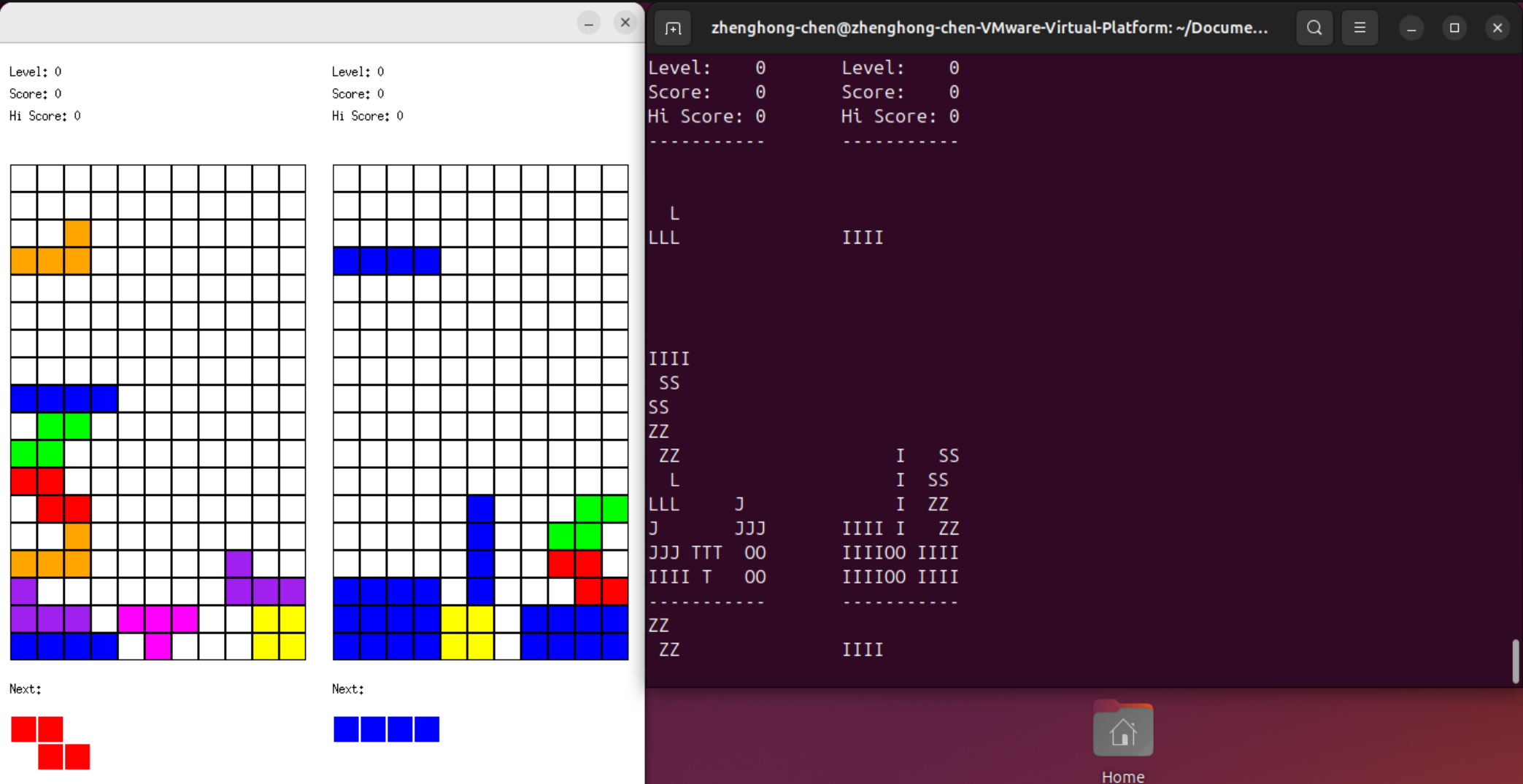
Text-Based Interface: Play the game using a terminal interface, suitable for environments without graphical support. Graphical Interface: Enjoy a graphical version of the game using the X11 library for rendering. Observer Pattern Implementation: The game uses the Observer pattern to decouple the game logic from the display logic. Extendable Design: The architecture supports easy addition of new features, such as special blocks, new levels, and effects. Configurable Levels: Levels can be configured to introduce new block types or behaviors. Blinding Effect: Implements a blinding effect where certain cells become hidden during gameplay. Timed Blocks: Introduces blocks that disappear if not cleared within a certain number of moves (optional feature). Customizable Commands: Supports renaming commands and creating macros for complex actions.
Object-Oriented Principles Low Coupling: Classes interact through well-defined interfaces, minimizing dependencies between modules.
High Cohesion: Each class has a single, focused responsibility, improving maintainability and readability.
Game: Manages the overall game flow, player turns, and game state. Player: Represents a player in the game, holding their board and score. Board: Manages the state of the game board, including cell states and block placements. Cell: Represents an individual cell on the board, holding its type and state. Observer (Abstract Class): Defines the interface for observers that update the display. TextObserver: Implements the Observer interface for text-based display. GraphicsObserver: Implements the Observer interface for graphical display using X11. Block and TimedBlock: Represents game blocks, with TimedBlock introducing disappearing behavior.
Observer Pattern: Decouples game logic from the display, allowing multiple observers to respond to game state changes. Strategy Pattern: Can be used for level behaviors and block generation strategies. Decorator Pattern: Applies effects like blinding or heavy blocks in a modular way. Command Pattern: Manages user commands, allowing for dynamic command addition and macros.
C++ Compiler: Compatible with C++11 standard or higher. X11 Library: Required for the graphical interface. Linux: Typically comes pre-installed. macOS: Install XQuartz. Windows: Use an X11 server like Xming and compile with Cygwin or WSL.
Clone the Repository:
git clone https://github.com/M4cr0Chen/Biquadris.git
cd Biquadrs/src
sudo apt-get install libx11-dev
Install XQuartz from https://www.xquartz.org/.
Install an X11 server and use WSL or Cygwin for compilation.
Compile the game using existing Makefile.
make
./biquadris [options]
-text: Run the game in text-only mode. -seed [number]: Set the random seed for block generation. -startlevel [number]: Start the game at a specific level. -scriptfile1 [file]: Specify a script file for player one. -scriptfile2 [file]: Specify a script file for player two.
Movements, Rotations, Dropping, and Level Controls can be executed with a multiplier, for example:
4levelup
The above command increases the level of the current player by 4. Insufficient commands can be interpreted, for example.
countercl
Will be interpreted as counterclockwise and executed.
- left: Move the block left.
- right: Move the block right.
- down: Move the block down.
- clockwise or cw: Rotate the block clockwise.
- counterclockwise or ccw: Rotate the block counterclockwise.
- drop: Drop the block immediately.
- levelup: Increase the level.
- leveldown: Decrease the level.
- rename [old] [new]: Rename an existing command.
- macro [name] [command sequence]: Define a macro command.
- The game starts with an empty board and a sequence of blocks.
- Players take turns moving and rotating blocks to fill rows.
- Completing a full row clears it from the board.
- The game introduces new block types and effects at higher levels.
- The game ends when a block cannot be placed on the board.
This project is licensed under the Apache 2.0 License. See the LICENSE file for details.
X11 Library: Used for rendering the graphical interface.
For questions or support, contact the project maintainer z253chen@uwaterloo.ca or w3zou@uwaterloo.ca.
- Modular Design: The project emphasizes modularity, making it easier to maintain and extend.
- Design Patterns: The use of design patterns like Observer, Strategy, Decorator, and Command contributes to a flexible and scalable architecture.
- Resilience to Change: The design allows for new features to be added with minimal impact on existing code.
- Networked Multiplayer: Implement a NetworkObserver to allow remote players to join.
- AI Opponents: Introduce computer-controlled players for single-player modes.
- High Score Persistence: Save high scores to a file or database for persistence across sessions.
- Enhanced Graphics: Use advanced graphics libraries for improved visuals.