| title | Testing randomness | |
|---|---|---|
| teaching | 15 | |
| exercises | 10 | |
| questions |
|
|
| objectives |
|
|
| keypoints |
|
Up until now we have been testing functions where the output is entirely predictable. In these cases, a handful of tests is usually enough to provide confidence that the software is working as expected. In the real world, however, you might be developing a complex piece of sofware to implement an entirely new algorithm, or model. In certain cases it might not even be clear what the expected outcome is meant to be. Things can be particularly challenging when the software is involves a stochastic element.
Let us consider a class to simulate the behaviour of a die. One is provided in the dice package.
$ cd ../dice
{: .language-bash}
Let's import it and see how it works.
from dice import Die
help(Die)
{: .language-python}
How could we test that the die is fair?
Well, first of all we could check that the value of a die roll is in range.
def test_valid_roll():
    """ Test that a die roll is valid. """

    # Intialise a standard, six-sided die.
    die = Die()

    # Roll the die.
    roll = die.roll()

    # Check that the value is valid.
    assert roll > 0 and roll < 7
{: .language-python}
$ pytest test/test_dice.py::test_valid_roll
{: .language-bash}
Great, that worked. But because die rolls are random, it could have been a fluke that the test passed this time. In practice, we need to check that the assertions hold repeatedly.
def test_always_valid_roll():
    """ Test that a die roll is "always" valid. """

    # Intialise a standard, six-sided die.
    die = Die()

    # Roll the die lots of times.
    for i in range(10000):
        roll = die.roll()

        # Check that the value is valid.
        assert roll > 0 and roll < 7
{: .language-python}
$ pytest test/test_dice.py::test_always_valid_roll
{: .language-bash}
That is a better test. But does it guarantee that the die is fair? No, it only guarantees that it won't return a number that isn't on the die.
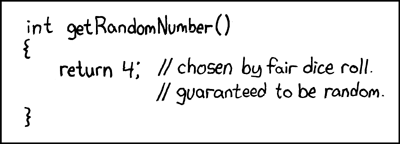
We still have more work to do to test that the die is fair.
Perhaps we should test the average value. We know that this should equal the sum of the faces of the die, divided by the number of sides. For a six-sided die, this is 3.5. Now, we will never achieve this exactly without an infinite number of rolls (even getting within machine precision could take billions of rolls), which we don't have time for.
Fortunately, pytest gives us a way to check things are approximately equal,
given some tolerance. pytest.approx() creates a number with an effective
"error bar"—a quantification of how far from the number we allow to be
considered "equal". Then any equality comparison with this approximate number
takes into account the uncertainty in it.
def test_average():
    """ Test that the average die roll is correct. """

    # Intialise a standard, six-sided die.
    die = Die()

    # Work out the expected average roll.
    expect = sum(range(1, 7)) / 6

    # Calculate the sum of the die rolls.
    total = 0

    # Set the number of rolls.
    rolls = 100000

    for i in range(0, rolls):
        total += die.roll()

    # Check that the average matches the expected value.
    average = total / rolls
    assert average == pytest.approx(expect, rel=1e-2)
{: .language-python}
$ pytest test/test_dice.py::test_average
{: .language-bash}
This takes us closer, but we're still not there. If we constructed a die with no
2 or 5, then the average roll would be (1 + 3 + 4 + 6) / 4; that is, 3.5.
We need to test that the distribution of outcomes is correct, i.e. that each of the six possible outcomes is equally likely.
def test_fair():
    """ Test that a die is fair. """

    # Intialise a standard, six-sided die.
    die = Die()

    # Set the number of rolls.
    rolls = 1000000

    # Create a dictionary to hold the tally for each outcome.
    tally = {}
    for i in range(1, 7):
        tally[i] = 0

    # Roll the die 'rolls' times.
    for i in range(0, rolls):
        tally[die.roll()] += 1

    # Assert that the probability is correct.
    for i in range(1, 7):
        assert tally[i] / rolls == pytest.approx(1 / 6, 1e-2)
{: .language-python}
$ pytest test/test_dice.py::test_fair
{: .language-bash}
The Die class has passed every test we've thrown at it, so we can be confident
that it is relatively bug-free for the cases we've tested for. Of course, so far
we've only tested 6-sided dice—we have no guarantee that it works for
other numbers of sides, yet.
The important upshot of this approach is that despite the fact that we could not predict the exact return value of our function, we were still able to test for exactly known invariants and guarantees upheld by it. You can extend this approach to any programming problem where the exact return value of a function cannot be meaningfully tested for, including those that are random or out of your control and those that are just exploratory. Start by focusing on what you do know, and write tests for that. As you understand more what the expected results are, you can expand the test suite.
The file
test/test_dice.pyin thedicedirectory contains an empty function,test_double_roll(), for checking that the distribution for the sum of two six-sided die rolls is correct. Fill in the body of this function and runpytestto verify that your test passes.To implement this test, you'll need to know that the probability of the sum of two rolls of an \(n\)-sided die having a value \(x\) is given by: \[p(x) = \frac{n-|x-(n+1)|}{n^2}\] for \(x\) between 2 and 2\(n\). This is implemented as a helper function
prob_double_roll(x, n)- for example,prob_double_roll(4, 6)calculates the probability of two 6-sided die rolls summing to 4.def prob_double_roll(x, n): """ Expected probabilities for the sum of two dice. """ # For two n-sided dice, the probability of two rolls summing to x is # (n − |x−(n+1)|) / n^2, for x = 2 to 2n. return (n - abs(x - (n+1))) / n**2{: .language-python}
def test_double_roll():
    """
    Check that the probability for the sum of two n-sided dice matches
    the expected distribution.
    """

    # Store the expected probabilities for the sum of two dice.
    expect = {}
    for x in range(2, 13):
        expect[x] = prob_double_roll(x, 6)

    # Create a dictionary to hold the tally for each outcome.
    tally = {}
    for key in expect:
        tally[key] = 0

    # Initialise the die.
    die = Die(6)

    # Roll two dice 'rolls' times.
    rolls = 5000000
    for i in range(0, rolls):

        # Sum the value of the two dice rolls.
        roll_sum = die.roll() + die.roll()

        # Increment the tally for the outcome.
        tally[roll_sum] += 1

    # Compute the probabilities and check with expected values.
    for key in tally:

        average = tally[key] / rolls
        assert average == pytest.approx(expect[key], rel=1e-2)
{: .language-python} {: .solution} {: .challenge}
Parametrize the test in the previous challenge so that it works for any pair of \(n\)-sided dice. Test this using five- and seven-sided dice.
@pytest.mark.parametrize("sides, rolls", [(5, 5000000), (7, 5000000)])
def test_double_roll(sides, rolls):
    """
    Check that the probability for the sum of two n-sided dice matches
    the expected distribution.
    """

    # Store the expected probabilities for the sum of two dice.
    expect = {}
    for x in range(2, 2 * sides + 1):
        expect[x] = prob_double_roll(x, sides)

    # Create a dictionary to hold the tally for each outcome.
    tally = {}
    for key in expect:
        tally[key] = 0

    # Initialise the die.
    die = Die(sides)

    # Roll two dice 'rolls' times.
    for i in range(0, rolls):

        # Sum the value of the two dice rolls.
        roll_sum = die.roll() + die.roll()

        # Increment the tally for the outcome.
        tally[roll_sum] += 1

    # Compute the probabilities and check with expected values.
    for key in tally:

        average = tally[key] / rolls
        assert average == pytest.approx(expect[key], rel=1e-2)
{: .language-python} {: .solution} {: .challenge}