While learning about IT infrastructure, I found a very well-organized article and studied while reorganizing it!
References: futurecreator.github.io
-
The foundation of a system including
hardware,OS,middleware,network, etc. needed to run an application -
Related to non-functional requirements
Functional requirement- What functions the system has and what it can do
Non-functional requirement- Requirements such as system performance, stability, security, etc.
- Hardware (HW)
- Server hardware, storage for data, power supplies, etc.
- In a broader sense, this also includes data center facilities where hardware is installed
- Server hardware, storage for data, power supplies, etc.
- Network
- Tools that connect servers so users can access them remotely
- ex)
- Network equipment such as routers, switches, firewalls
- Cable wiring connecting them
- Access points (AP) needed for users to connect wirelessly from terminals
- ex)
- Tools that connect servers so users can access them remotely
- Operating System (OS)
- Basic software for controlling
hardwareandnetwork equipment - Manages resources and processes
Client OS- Focuses on making it easy for users to use
- ex) Windows, macOS
Server OS- Focuses on running systems quickly and stably
- ex) Linux, Unix, Windows Server
- Basic software for controlling
- Middleware
- Software that provides functionality to make the server perform a specific role on the server
- The traditional approach of placing servers in a data center or server room and managing them directly
- Required purchasing, installing, and managing servers, network equipment, OS, storage, various solutions, etc.
- Equipment is expensive, so initial investment costs are high
- Difficult to estimate usage, so once built, maintenance costs remain the same even with low usage
- A system provided as a service to an unspecified majority through the internet
- What does
service formmean?- Users select desired options and pay for what they use
- ex) IaaS (select VMs or storage with desired specs, pay based on usage time or data volume), PaaS, SaaS
- What does
- Cloud Providers like AWS, Microsoft Azure, GCP own data centers and infrastructure
- A form of Public Cloud with limited users
- ex) Internal corporate services - Good security, easy to add proprietary features or services
-
Cloud is advantageous for systems with high traffic variability
- Why?
- Because it is not easy to predict traffic for external services!
- Estimating server specs or network bandwidth based on traffic volume is called Sizing, which is quite a difficult task
- Cloud systems have
Auto Scalingthat automatically scales based on traffic fluctuation, making it more advantageous than On-premises!
- Cloud systems have
- Why?
-
Even if a data system goes down due to natural disasters, the system can be operated from elsewhere
- How?
- Because cloud data centers are spread around the world!
- How?
-
Cloud is also advantageous for systems that need to provide services quickly or PoC (Proof of Concept)
- Also advantageous for startups / individual developers with low initial investment!
- Both On-premises and Cloud guarantee availability, but there is a difference in concept
On-premises- Aims for servers not to go down
Cloud- In a distributed environment with many instances, if an instance goes down, another instance quickly replaces it
- In other words, using Cloud does not guarantee availability; you must design it to increase availability yourself
- Therefore, On-premises is advantageous for systems that must never be interrupted even briefly or need availability beyond what cloud providers guarantee...
- That being said, I can't quite agree with this part..!
- Taking Amazon RDS as an example, there are many methods that come to mind right now, such as using multi-AZ deployments for failover, provisioning and maintaining synchronous standby replicas in other availability zones, etc., to increase availability!!
- I wonder if On-premises can guarantee availability beyond what Cloud can offer! I should look into it
- That being said, I can't quite agree with this part..!
- In a distributed environment with many instances, if an instance goes down, another instance quickly replaces it
- On-premises is advantageous for data with high confidentiality
- Of course, the security provided by Cloud Providers may be better than your own, but On-premises is advantageous when you need to know the exact physical storage location
- Also, if using multi-cloud, security standards are difficult to establish because each Cloud provider has different security policies...
- I have joined a Multicloud project in the new open source contributhon, and I hope to find out if this part is really difficult during the contributhon! I should look into it
- Since both On-premises and Cloud have their pros and cons, both are sometimes used together
- Using both according to the characteristics of each system!
- Since cloud providers also have different strengths and weaknesses, multiple clouds are sometimes used together
- To make good decisions about this, you need to know the characteristics of each well, and the criteria for selection must be clear!
- Hardware and Network are the most low-level elements of Infrastructure
- In On-premise systems, it consists of multiple server machines
- In Cloud, you select hardware performance of instances as needed
-
CPU performance is influenced by Core and Cache
- The more Cores, the more concurrent computations can be processed
- Cache, which alleviates the processing speed gap with memory, performs better with larger size
-
GPU
-
A processor specialized in graphics processing
-
While
CPUconsists of a few cores optimized for serial processing,GPUconsists of many small cores optimized for parallel processing

-
In fields that require high-speed processing of large amounts of data, such as deep learning or numerical analysis, GPU Computing is used to boost processing performance by using CPU and GPU together
- This method offloads computation-heavy parts to the GPU and processes only the remaining code on the CPU! Interesting..

-


- Main memory performs better with larger data capacity and faster transfer speed
- For server use, memory with low power consumption and built-in error handling is typically selected
- A device that stores data
- Since storage is usually the slowest component, the storage capacity and read/write speed often affect the overall system speed
- Consists of
hard disks,SSD (Solid-State Drive), etc.
-
The most important thing in IT can be said to be data
-
Since this data must not be lost, most systems are configured with redundancy or multiple redundancy for high availability (HA, the ability to operate continuously over a long period)
-
ex)
-
Configuring redundancy by distributing AWS RDS across different
Availability Zones (AZ)within the same Region
- AWS calls this Multi-AZ Deployment
- Even within the same region, data is distributed so if the Master has a problem, the Slave recovers and maintains data
-

- A firewall controls communication between the internal network and external network for security, blocking unnecessary communication
- ex)
- Packet filtering type
- Filters passing
packetsbased onport numbersandIP addresses
- Filters passing
- Application gateway type
- Controls communication with the outside at the application protocol level, commonly called a
proxy server - To inspect information contained in sessions, it terminates the existing session and creates a new one
- Slower than packet filtering type but can perform more inspections
- Controls communication with the outside at the application protocol level, commonly called a
- Packet filtering type
Networks use network addresses to identify various equipment
: A physically assigned 48-bit address
- The first 24 bits identify the network component
manufacturer - The last 24 bits are
assigned uniquelyby each manufacturer - Expressed in hexadecimal, separated by 2 bytes
: A number assigned to equipment connected to a network such as the internet or intranet
- The commonly used IPv4 is a 32-bit address divided into 4 groups of 8 bits each
- ex) 192.168.1.1
- Each position can represent 0 to 255
- IPv4 can only connect up to 2^32 (approximately 4.2 billion) devices on a single network, raising concerns about IP address exhaustion on the internet
- That is why IPv6 uses 128-bit IP addresses!!
- Internal networks use private addresses with arbitrary address assignments and use NAT devices to convert to global addresses at the boundary with the internet
-
When communicating, 1) rules for how to exchange messages and 2) what language to use are needed
- These conventions are called communication protocols
-
The
OSI (Open Systems Interconnection) Modelis a model that divides computer communication functions into a layered structure, created by the International Organization for Standardization (ISO) -
Using the OSI Model, you can visually understand what happens in a specific networking system using layers
-
The OSI Model consists of a total of 7 layers
- Data -> when going out to the network, from the top layer
- Network -> when receiving data, from the bottom layer

- The layer where transmission cables are directly connected, functioning to transmit through cables
- The function of sending and receiving data!
- Defines voltage & current values, and specifies the
physicalandelectricalcharacteristics of communication equipment such as cable and connector shapes- ex) Twisted pair cables (STP/UTP) used for LAN cables, Ethernet standards like 100BASE-T, or IEEE802.11 series wireless communication
- Defines communication between two adjacent systems (Nodes) within the same network
- Responsible for node-to-node delivery!
- Verifies that the physical layer is functioning properly
- Receives
data packetsfrom the network layer and adds MAC addresses and various control information- The data unit with additional information is called a frame, which is transmitted through the physical layer
- Defines rules for communication between different networks
- Has a routing function that efficiently processes paths to specific servers
- While the data link layer is based on MAC addresses, the network layer is based on IP addresses
- Responsible for safely delivering data from source to destination
- For this purpose, it has:
- Flow control function that controls packet flow when there is heavy packet traffic
- Error control function that detects packets lost during transmission and requests retransmission
- For this purpose, it has:
- Representative equipment includes routers and L3 switches
- Such equipment manages a
routing tablethat stores information about where to forward packets- Static route that determines routes based on the routing table
- Dynamic route set by routing protocols
- An
L3 switchis equipment that processes the same functions as a router in hardware!
- Such equipment manages a
- The layer that controls data transmission
- Handles the volume, speed, and destination of data to be sent
- The session layer's messages are divided into segments, with sequence numbers recorded for each segment, sent to the network layer, and reassembled on the receiving side
- This method specifies transmission error detection and retransmission
- Representative protocols include
TCPandUDP
- Responsible for maintaining and releasing
connectionsbetween applications - Defines connection establishment timing and data transmission timing, etc.
- Responsible for converting data so applications can understand it
- Handles conversion of data storage formats, compression, character encoding, and also processes
encryptionanddecryptionfunctions for secure data transmission
- The top layer, referring to applications directly used by users such as web browsers or Outlook
Now that we've covered hardware and networking, let's look at the OS
-
Linux is a Unix-compatible server OS developed by Linus Torvalds
-
According to the Linux Foundation:
-
90% of public cloud workloads
-
82% of the world's smartphones
-
62% of embedded devices
-
99% of the supercomputer market runs on Linux
-
Linux is open source, built with the participation of various companies and individuals
- It is said to be the open source project with the most contributors in computer history!
-
The Kernel is the core part of the OS
-
Roles of the Linux Kernel:
- Memory management
- File system
- Process management
- Device control
-
Android is also built on the Linux Kernel
- The Linux Kernel controls hardware such as CPU, memory, disk, and IO using software called device drivers
- Linux reads the contents written in program files and processes them in memory; the executed program is called a process
- Processes are managed by assigning PID (Process ID) and efficiently allocating necessary resources to each process
-
Users can send commands to the kernel through a Command Line Interface called Shell
-
A collection of commands to be executed in the Shell is called a Shell Script
Shell Name Features bash - Supports command history, directory stack, and auto-completion for commands and file names
- Comes standard in most Linux systems and macOS (OS X)csh - A Shell similar to the C language
- Mainly used in BSD-based OStsch An improved version of csh that supports auto-completion for commands and file names zsh A Shell compatible with bash that operates at high speed
- A file system is a scheme that names files and indicates where to store them
- A system for managing files
- The Linux Kernel uses a Virtual File System (VFS)
- It allows users to use data as if they were regular files regardless of where they are stored (hard disk, memory, network storage, etc.)!
- The Virtual File System (VFS) treats each device as a file

ext2- A file system widely used in the Linux operating system
- Called ext2 because it extended the initial ext file system
ext3- A file system mainly used in Linux
- Available from Linux Kernel 2.4.16!
- A file system mainly used in Linux
ext4- The successor file system to ext3
- Storage supports up to 1EiB
- Supports extent file writing that prevents file fragmentation
tmpfs- A device for temporary files in Unix-based OS
- Can be stored in memory
- Often mounted as /tmp, and since it is stored in memory, all files are lost when the server restarts!
- That's right..... they all disappear..
UnionFS- A file system that can layer multiple directories and treat them as a single directory
NFS- A distributed file system and protocol used in Unix
- Linux's directory listing is standardized by a specification called FHS (Filesystem Hierarchy Standard)
- Most major distributions compose their directories based on FHS
| Directory | Description |
|---|---|
/ |
Root directory |
/bin |
Directory storing basic commands like ls, cp |
/boot |
Directory storing files needed for OS booting, such as the Linux Kernel |
/dev |
Directory storing device files for hard disks, keyboards, etc. |
/etc |
Directory storing configuration files for OS or applications |
/home |
- Home directory for regular users - Root user uses /root as home directory! |
/proc |
- Directory storing information about kernel and processes - Numbered folders under /proc represent Process IDs! |
/sbin |
Directory storing system administration mounts |
/tmp |
- Directory for temporarily used files - Deleted when the server restarts |
/usr |
Directory storing various programs and kernel source |
/var |
Directory storing files that change with system operation |
- Account-based permission settings
- Linux can set permissions for user accounts
- There is a
rootuser who manages the entire system and other regular users- There are also system accounts for running middleware daemons
- Accounts can be grouped!
- Based on accounts and groups, access permissions for files or directories can be set
- Network filtering
- Linux was originally built as an OS intended for multiple users on a network, so it has many network-related features
iptablesis a feature built into Linux that can configure packet filtering and NAT
- SELinux (Security-Enhanced Linux)
- SELinux is provided by the U.S. National Security Agency, adding mandatory access control features to the Linux Kernel
- In Linux, the root user can access everything regardless of permissions, so if the root account is compromised, it can have critical impact on the system
- SELinux prevents power concentration on root with
TE (Type Enforcement)that restricts access per process andRBAC (Role-based Access Control)that controls all users including root- Interesting!!
- SELinux prevents power concentration on root with
-
Usually, Linux is distributed as packages called distributions that include various commands, libraries, and applications on top of the kernel
-
There are various distributions because different people want different programs and Linux is open source, allowing individuals or companies to modify and use it
-
Distribution Types
-
Debian-based
-
Debian
: Linux developed by the GNU/Linux community
-
KNOPPIX
: Linux that can be used with CD booting
-
Ubuntu
: Linux providing a rich desktop environment Ubuntu is the best
-
-
Red Hat-based
-
Fedora
: Linux from the
Fedora Projectcommunity supported by Red Hat -
Red Hat Enterprise Linux (RHEL)
: Commercial Linux provided by Red Hat
-
CentOS
: Linux aiming for complete compatibility with RHEL
-
Vine Linux
: Linux developed in Japan
-
-
Slackware-based
-
openSUSE: Linux developed by a community supported by Novell
-
SUSE Linux Enterprise: Stabilized commercial Linux based on openSUSE
-
-
Other Distributions
-
Arch Linux: Linux that uses Pacman as its package management system
-
Gentoo Linux: Linux that uses Portage as its package management system
-
-
- Middleware refers to various software that sits between the OS and business-processing applications
- ex) Web Server, DBMS, System monitoring, etc.
- A Web Server is a server that receives HTTP requests from clients and returns Web Content as responses or invokes server-side applications
| Name | Description |
|---|---|
| Apache HTTP Server | A widely used traditional open source web server |
| Internet Information Services | - A web server provided by Microsoft - Included with OS products like Windows Server series |
| Nginx | Has low memory consumption |
- A Database Management System (DBMS) is middleware that manages databases
- It includes basic functions such as CRUD (Create, Read, Update, Delete) and many features including Transaction processing
- There are various types of DBMS
- Since syntax varies significantly between vendors, there is a standard called
ANSI SQL - Since each DBMS varies greatly in supported features, performance, and price, choose according to the required purpose!
| Name | Description |
|---|---|
| Oracle Database | - A commercial RDBMS provided by Oracle - A database widely used by enterprises, with the #1 global DB market share - Provides many features at a correspondingly high price |
| MySQL | - An open source relational (Relational) DBMS provided by Oracle - The most widely used open source RDBMS - Sun acquired the maker MySQL AB, and then Oracle acquired Sun, making Oracle the owner- Split into a free community version and a paid commercial version - Later, the open source community created MariaDB based on MySQL |
| Microsoft SQL Server | - A commercial RDBMS provided by Microsoft - Specialized for Windows |
| PostgreSQL | An open source RDBMS with the 4th largest global market share after Oracle, MySQL, and SQL Server |
- NoSQL refers to DBMS that does not use only SQL
- Instead of tables, data is stored in other formats
- Rather than one being better than the other compared to RDB, it is important to use whichever fits the purpose!
| Type | Description | Examples |
|---|---|---|
| Key-value | - The simplest form of NoSQL - Simple, so it is fast and easy to learn - Queries based on value content are not possible, so processing at the application level is necessary |
Redis Amazon DynamoDB Memcached |
| Document | - Similar to Key-Value but stores hierarchical documents instead of simple values - Queries can be used but differ from standard SQL |
MongoDB Couchbase |
| Wide column stores | - Uses tables, rows, and columns but unlike RDB, column names and formats can differ even within the same row - A 2-dimensional key-value format |
Cassandra HBase |
| Graph | - Stores data as continuous nodes, edges, and properties like a graph - Suitable for data relationship-focused use cases like SNS, recommendation engines, pattern recognition |
Neo4j |
- System operation requires continuous monitoring of various states
- Monitoring is performed at various levels including Network, Server, Cloud, Application, Service, and Transaction to check for anomalies and analyze causes
| Name | Description |
|---|---|
| Zabbix | - An open source monitoring tool developed by Zabbix SIA- Can monitor the status of various servers |
| Datadog | - A server monitoring SaaS developed by Datadog- Can monitor from a web browser without needing a separate server - Easy monitoring even in multi-cloud environments |
| Mackerel | - A server monitoring SaaS developed by Hatena- Useful for cloud server monitoring |
Infrastructure configuration management refers to the work of managing configuration information for hardware, network, OS, middleware, applications, etc. that make up the infrastructure, and maintaining them in an appropriate state
- In On-premise environments, building an infrastructure environment is a big task, and once built, it is used for a very long time while organizing change history
- But with Cloud, since it is a virtual environment, you can build when needed and discard immediately when not needed!
- In other words, when a service is updated, instead of changing the existing operating environment, a new
imageis created and deployed- This is called Immutable Infrastructure, meaning it does not change
- In other words, when a service is updated, instead of changing the existing operating environment, a new
- But with Cloud, since it is a virtual environment, you can build when needed and discard immediately when not needed!
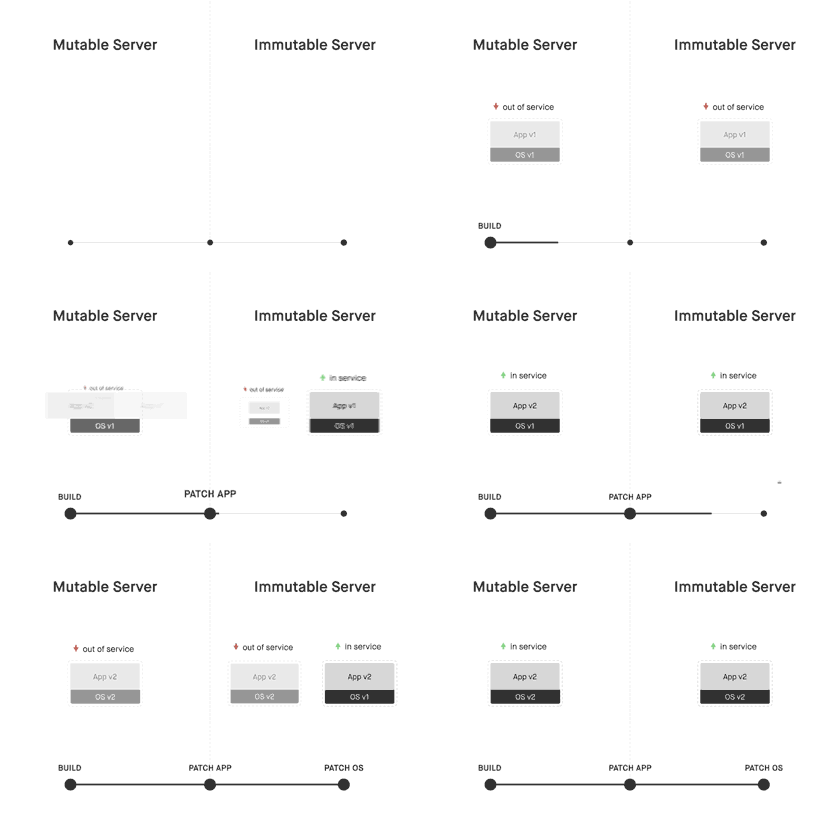
- Immutable Infra allows easy server creation from a single
image, and since only thatimageneeds to be managed, management is also easy! - Since the environment itself is deployed, testing in an identical environment is also easy
Still studying...