Yesterday, Roo bought some new flip flops. Let's see how good at flopping you are.
Attachments: flop.py
| Symbol | Meaning |
|---|---|
| ⊕ | Bitwise XOR |
| || | Concatenation |
We can perform up to 3 queries, each corresponding to either of the following:
- Encrypt an arbitrary plaintext that does not contain "gimmeflag". The plaintext is padded with PKCS#7 before encryption. We are given the ciphertext.
- Decrypt an arbitrary ciphertext. If the plaintext contains "gimmeflag", we are given the flag. We are not given the plaintext.
All encryption/decryption operations are done under AES-CBC with fixed unknown key and iv. The server reads the plaintext/ciphertext in hex so that we can send any bytes.
Goal: Forge a ciphertext
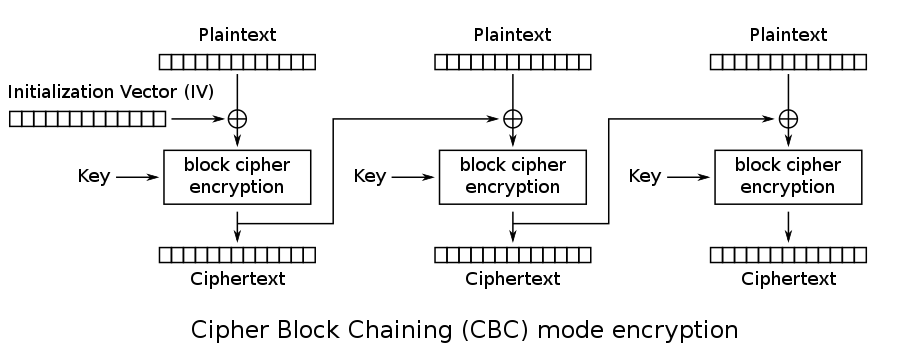
Due to how CBC works, we can get one block of ciphertext to decrypt to any plaintext with the following process:
Let p be the desired plaintext block. Let p1 and p2 any other plaintext blocks. We call ENC(x) the AES encryption operation, independent of mode. That is, it corresponds to the "block cipher encryption" box in the image. We call DEC(x) the inverse operation.
First, encrypt p1 || p2. We call the resulting ciphertext c1 || c2. Now as per CBC, we have the following equations:
c1 = ENC(p1 ⊕ iv)c2 = ENC(p2 ⊕ c1)
Now can we use that to somehow find the c such that DEC(c) = p ? The answer is no! We'll use and abuse CBC instead.

A nice set of properties to remember about XOR is that it is associative [(a ⊕ b) ⊕ c = a ⊕ (b ⊕ c)], self-inverse [a ⊕ a = 0], and possesses a neutral element [a ⊕ 0 = a].
Now this can be useful, because DEC(c2) = p2 ⊕ c1 by definition.
If we somehow manage to XOR DEC(c2) with p2 ⊕ c1 ⊕ p, the p2 ⊕ c1 part would cancel out and we would be left with p only ─ just what we want!
But is there a way to perform that XOR? Yes!
If we send (p2 ⊕ c1 ⊕ p) || c2 to the server for decryption, CBC will ensure that the following happens:
Let P1 the first decrypted block, P2 the second.
P1 = DEC(p2 ⊕ c1 ⊕ p) ⊕ ivP2 = DEC(c2) ⊕ p2 ⊕ c1 ⊕ p = p2 ⊕ c1 ⊕ p2 ⊕ c1 ⊕ p = p
Neat.
We nearly got everything we want, there are only some details left to implement. One thing to consider is that before encryption, plaintexts are padded with PKCS#7. That means, if we merrily send our 16-bytes plaintexts, a block consisting of only 0x10 repeated 16 times will get appended! Luckily that's not a problem, as we can just consider the first two encrypted blocks and forget about the rest.
For simplicity, I took p1 = p2 = 0 to have less things to XOR together:
from Crypto.Util.Padding import pad
from pwn import remote, xor

p = pad(b'gimmeflag', 16)
p1 = p2 = b'\0'*16

r = remote('chal.imaginaryctf.org', 42011)
r.sendlineafter('> ', '1') # Option: Encrypt
r.sendlineafter(': ', (p1+p2).hex())

raw = bytes.fromhex(r.recvline(False).decode())
c1 = raw[00:16]
c2 = raw[16:32]

r.sendlineafter('> ', '2') # Option: Decrypt
r.sendlineafter(': ', (xor(c1, p) + c2).hex()) # We don't need to xor p2 = 0
r.interactive()